Most LIMS ROI articles will tell you the software pays for itself in reduced headcount within a year or two, and that the hard part is getting the budget approved. Both are wrong. In this article, we show what a LIMS costs when you count everything, what labs really get back, and how to build a business case that lands with your manager.

So you've had it with the manual work: results re-entered by hand, audit preparation eating three weeks…you know how it goes. Now you have to convince your Managing Director to sign off an investment in LIMS, and it doesn't feel like a small ask.
Search online and every article tells you to calculate the hours your team will save, multiply by salary, land on a payback period, and walk in with the number. If it were that simple, more labs would have done it already.
But when we surveyed 110 QA/QC labs for our 2026 State of Lab Digitalization Report, “hard to build a business case” was one of the reasons labs haven't moved forward. Why is that? And what goes into a LIMS business case? Read on to see what a LIMS TCO is (all of it, not just the license), what labs get back, and how to walk into that meeting with a case your manager will listen to.

Most lab managers can point to the places where their lab wastes time and money. Things like the test that had to be rerun because a result was entered wrong, or the two weeks someone spent assembling records before the last audit. Everyone in the lab sees (and feels) those. The problem is that everyone outside the lab doesn't.
“To leadership, the lab is often a black box. Samples go in, results come out, and assumption is that the middle just works,” says Gerard Ipskamp, a LIMS consultant with 20+ years in the field. The reruns, workarounds, and hours lost to manual re-entry all stay inside that box.

Frifag, a Swiss poultry producer, is a good example of what can live inside this black box. When they audited their lab processes, they saw their QA staff spent half the time managing data: re-entering paper forms in Excel and emailing results between systems. One full-time employee devoted a third of their hours to this task alone, which is CHF 22,400 in annual labor costs, and it had just become how things worked.
Frifag isn't an outlier. Open most lab black boxes, and you'll find Excel holding everything together. In fact, more than half of labs use it for day-to-day work. Even among labs that have a LIMS, a third still run Excel alongside it.
Excel became the default because it has long been the only practical way to pull data from different instruments and systems into one place. Because it worked, it stayed. But useful isn't the same as purpose-built. A 2024 literature review synthesizing 35 years of spreadsheet research highlights: about 94% of operational spreadsheets contain faults. In a lab where someone is copying instrument readings between systems under time pressure, the odds of a wrong result entering the system don't improve.
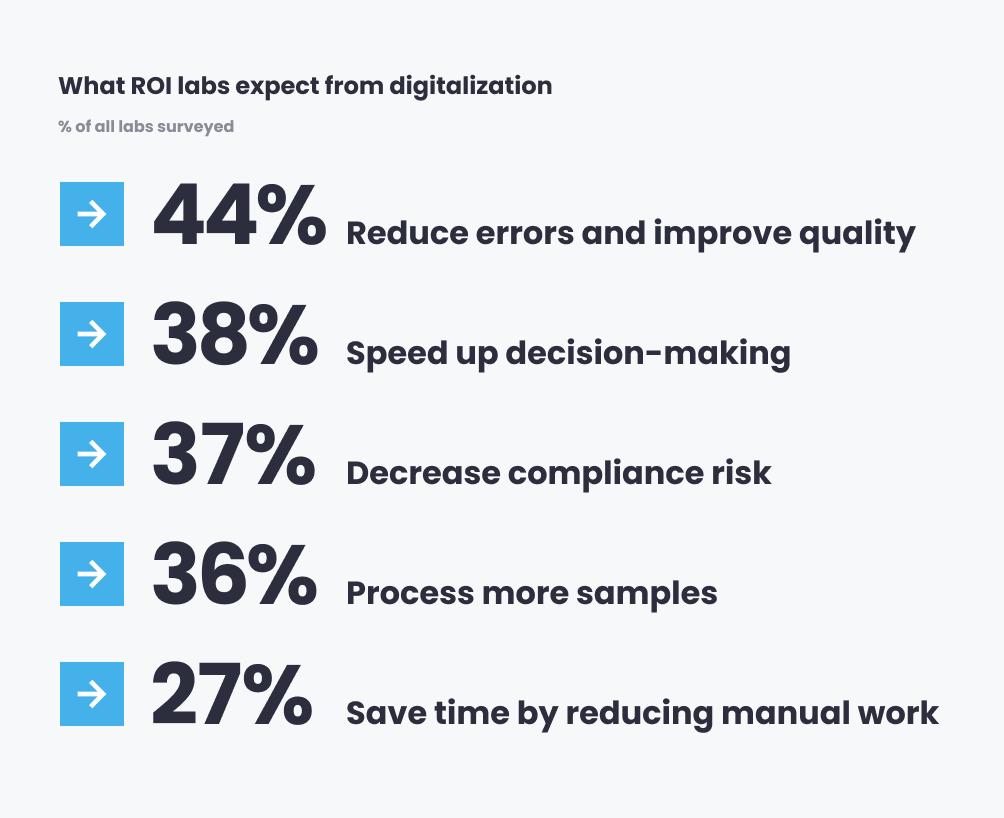
That said, in our survey of 110 QA/QC labs, 44% answered that their top ROI expectation from digitalization is to reduce errors and improve quality, above anything else. Errors rank first because the current setup produces them most reliably.
With the cost of running a manual workflow often unmeasured, building a business case for getting a LIMS feels hard. If you're preparing one, you’d assume your Managing Director will say no because of money. Our data shows budget is not the main obstacle.
You're ready to make the case for a LIMS. You've got a vendor in mind, calculated the cost, estimated hours saved, maybe run it through an ROI calculator. You walk in ready to defend the investment. But the truth is, budget is most likely not what your manager is thinking about.
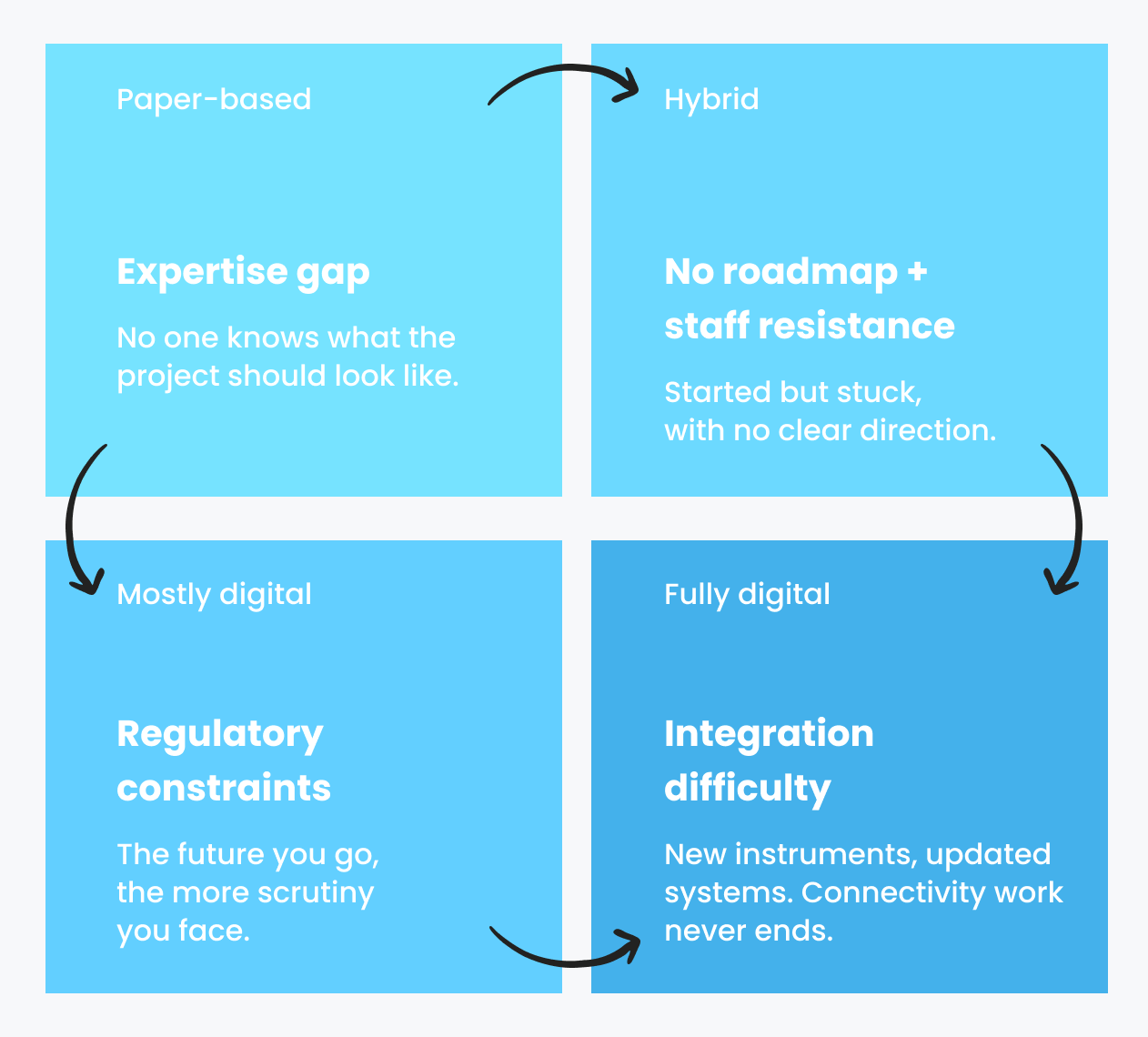
Only 7% of labs cite budget as what's holding back their digitalization. It ranks last. If not budget, what else is preventing labs from digitalizing? Your manager’s real hesitation is more likely about:

We also found that the barrier shifts as labs move through their digitalization journey. Labs that have started but aren't fully connected tend to face staff resistance and no clear direction. Labs further along run into regulatory scrutiny.
We'll come back to advice on how to approach building your business case later in the article. First, it helps to know what you're actually committing to — because the license fee is never the whole number.
Estimating a LIMS's true TCO is harder than it should be. Vendor pricing pages often only list the software cost, and even that number sometimes hides behind a "book a demo" button. The other cost components (implementation, configuration, integration, training, ongoing maintenance) rarely appear anywhere public. Public benchmark data on LIMS pricing is scarce for the same reason.
This section shares what we know from our own experience at 1LIMS. The numbers are our own estimates, so treat them as a baseline.
A more complete picture of a LIMS's TCO includes six cost components:
Software cost comes in two models:
Implementation is usually a one-time project. The vendor sets up your new LIMS, migrates your data, maps your workflows, and onboards your team. For most labs this runs €5,500–€23,000 as a one-time cost, depending on lab size and complexity:
Historical data migration deserves special attention. Moving years of existing records into a new LIMS takes time, and vendors handle it differently. Some include it in the setup, others charge separately once you've signed. It's worth asking early where any given vendor draws that line. At 1LIMS, migration is included for free in our one-month setup.
The next three processes (configuration, integration, and training) happen during implementation. But they don't stop there. Your lab keeps changing: new instruments arrive, processes get updated, people leave and join the team. Every one of those changes means going back into the system to configure, integrate, or retrain again. That's why they deserve their own line in a TCO calculation.
“Buying the software is the easy part. Getting it configured to your processes is where things get hard,” says Patrick Courtney, board member at SiLA (Standardization in Laboratory Automation). Configuration means mapping the LIMS to how your lab actually works: the tests you run, how results get approved, how reports come out. In practice, it's the cost most labs underestimate.
Configuration in a complex legacy environment can range from a few hundred euros for a basic setup to €6,000+ for a large, complex operation. The bigger factor is how much of the work requires engineers or consultants versus how much your lab manager can do directly. A system a lab manager can configure directly costs less to adapt.

Integration means connecting your LIMS to your instruments, ERP, external labs, customer portals, and other systems in use. Each connection is typically scoped and priced separately. Connecting an external lab's data to your LIMS, for example, can run around €3,500.
The reason integration gets expensive is that every instrument and system speaks its own language. Legacy devices have proprietary interfaces that require custom work to bridge, so every connection is essentially built from scratch. The more open and standards-based the system, the less custom work each connection requires — and the lower this ongoing cost.
Training is the line item most labs underestimate. But it’s the one most responsible for whether the whole investment pays off. Reddit threads, G2 reviews, and industry surveys tell the same story: LIMS implementations drag on for months, go-live dates slip, and staff go back to their spreadsheets one by one. At one global biotech, adoption stalled at 5% of available features even after abundant training.
Mr. Courtney puts a rough ratio on it from years of watching these projects: for every euro you spend on the technology, expect to spend four or five on change management.
Vendors handle training differently. Some include a standard set of onboarding workshops and user training in the implementation package. Others charge separately for every session. It's worth asking where a vendor draws that line before you sign.
At 1LIMS, standard onboarding and user training are included. Labs that want a deeper starting point can add LabCheck (€6,500, fixed price). It’s an on-site or remote workshop where our experts map your processes end to end and identify where time and effort get wasted. It’s how Frifag quantified what their manual workflow was costing them (the 32% of a QA employee's working hours we mentioned earlier). The workshop also projected the savings: bringing that workload down to 10% and saving around CHF 15,400 annually.
Maintenance covers updates, technical support, bug fixes, and internal management. The cost depends on how the system is deployed:
That's the full TCO picture. Here it is in one view:
What goes into LIMS TCO and what makes it grow
A mid-size lab (10 users, ~200 samples/day, moving from Excel and paper) typically lands around €25K–45K in Year 1 all-in, with recurring costs of €7K–12K after that. Larger multi-site operations and heavily regulated environments push higher, especially where legacy instruments require custom integration work.
Before you build the ROI side of your business case, you should know which returns matter. Most LIMS pitches lead with hours saved and headcount reduced. But labs don't invest in a LIMS to cut headcount. In most European labs, for example, labor isn't even the biggest cost line. The bigger prize, as Lukas Bromig, founder of UniteLabs, puts it, is reproducibility, traceability, and data quality. In practice, that means data that survives an audit and lets the business make decisions without checking twice.
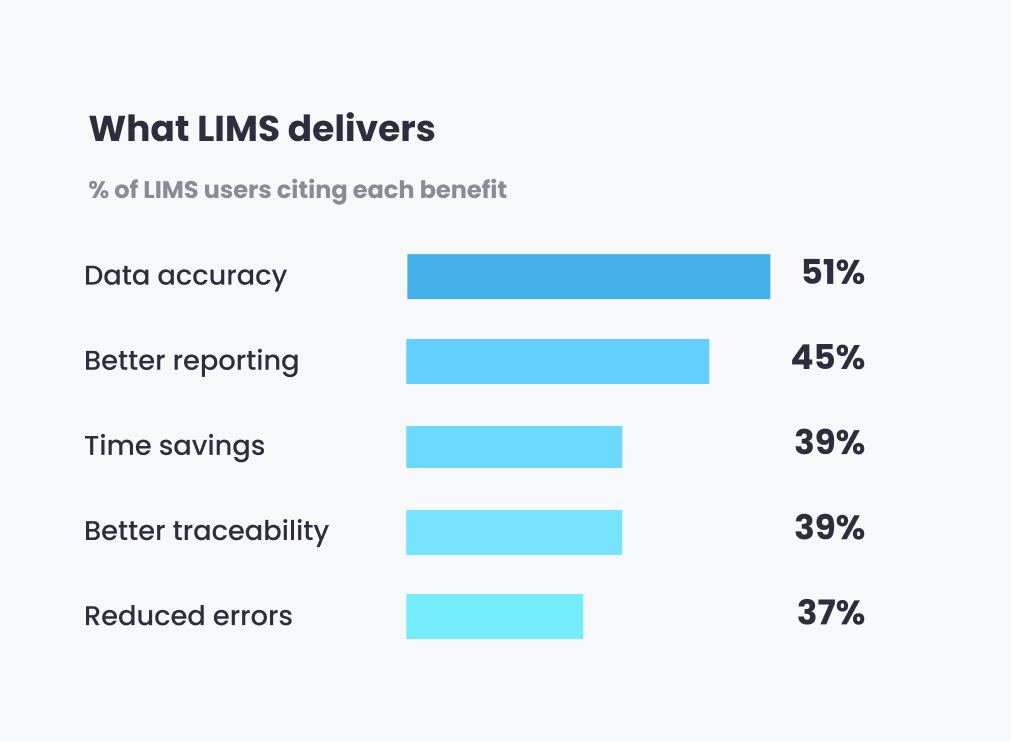
You don't have to take a vendor's word for what a LIMS delivers. Labs already using one told us in our survey. Data accuracy leads at 51%, followed by better reporting (45%), time savings (39%), traceability (39%), and reduced errors (37%).
Here's how those returns break down in practice.
Manual re-entry, disconnected spreadsheets, and paper trails all create room for wrong numbers to slip through. A LIMS closes those gaps by taking the reading straight from the instrument into the system. When a value looks wrong or a field is missing, it flags the problem before the result moves anywhere else.
At Zweifel, a Swiss chip manufacturer, sample loss dropped to zero after implementation. At Model AG, a LabCheck audit projected an 87% reduction in errors after moving from their patchwork of Access, SAP, Excel, and paper to a single system. Across 1LIMS clients, error reduction typically lands around 75%.
Every caught error saves a rerun, which saves hours, reagents, and instrument time. Multiply that across a year, and it's a recall you didn't have to issue.
This is the argument for growing labs. A LIMS clears the admin bottleneck, which frees your existing team to process more without adding people.
Take Micarna, a Swiss food producer running 23 sites. After implementing 1LIMS, they increased sample throughput by 50%. Model AG's LabCheck projected a 31% throughput increase without adding a single FTE.
If your lab is in a regulated industry like food, pharma, and chemicals, you know the drill before an audit. A LIMS changes that structurally. Every result is timestamped, every user action logged, and every record is traceable back to its source. When an auditor asks a question, the answer is a few clicks away.
At Polygal, a Swiss producer of raw materials for the food and pharma industries, quality data became accessible across the team instead of stuck with a lab manager, Sindy. COA generation, previously a manual document-creation step in Word, was automated. Trend analysis, which used to take hours, now takes five minutes. Meeting IFS and FSC 2200 requirements became a routine part of daily operations

Your manager is still going to ask about cost savings, so here are some numbers.
At Model AG, our LabCheck projected annual savings of around CHF 41,000, a 50% reduction in data management workload, and a 45% reduction in quality analysis costs. At Frifag, the projection was around CHF 15,400 saved per year with the QA workload dropping from 32% to 10% of one employee's working time, and a projected 71% ROI on the investment. The savings come from three places:
Numbers vary by lab size and starting point, but the pattern is consistent: cost is freed up every year.
All four of these returns reinforce each other:
That's why ROI conversations get confusing when they're built around a single payback period. What you actually get back is four categories compounding every month you own the system.
Now you know what a LIMS costs and what it gives back. The final piece is how to turn that into an argument your manager will respond to.
At this point you have the costs and the returns. Turning them into a number your manager can respond to takes two formulas and one honest example.
Let’s start with the formula.
Annual net benefit is what your lab gets back per year — labor freed up, reruns avoided, audit prep time recovered — minus recurring costs like subscription and ongoing maintenance.
Total investment is what it costs to get running: software (Year 1), implementation, and the setup work around configuration, integration, and training.
Both numbers depend on your starting point. A paper-based lab has more to gain than one already running Excel with some automation. A single-site 10-person lab produces different math than a 23-site operation like Micarna.
Frifag, the Swiss poultry producer from earlier, is a useful case because we published both sides of the math after their LabCheck audit.
Annual net benefit: CHF 15,400. Their QA workload dropped from 32% to 10% of one employee's time. That freed roughly 350 hours a year of skilled labor — enough to run more samples, catch more issues, and cut the manual data-management risk that had been hiding in the workflow.
Total investment (Year 1): ~CHF 21,700. Subscription for their lab size, implementation, configuration for their QA workflows, integration with existing systems, and training.
ROI: 71%. (15,400 ÷ 21,700 × 100)
Payback: about 17 months. (21,700 ÷ ~1,283 monthly)
Year 2 onward, the only recurring cost is subscription and ongoing maintenance. So a lab that invests around CHF 22K in Year 1 sees the full CHF 15K flow to the bottom line every year after — often more, as the team gets faster with the system.
Every lab's inputs differ, but a few patterns from our LabCheck engagements are worth using as reference points:
If your inputs land outside these ranges, that's a signal to sanity-check the assumptions — either your current setup is more efficient than most, or something in the estimate needs another pass.
Start by picking the single most pressing problem in your lab. Not a category like “manual work is inefficient”, but a specific incident. For example, the batch you had to hold last month because the QA result was entered wrong. Or the client who asked for traceability data and you had to collect it from four different places.
Don't try to solve it before the meeting. “Make it visible instead,” says Mr. Ipskamp. That means walking in with the number: how many hours it cost, how many people were involved, or how close the audit came to slipping. If you can't put a number on it, describe what almost went wrong.
From there, the specific angle depends on what your manager is most likely worried about. Back at the top of this article, we saw that budget isn't usually what makes managers hesitate.
For most labs still on manual or hybrid setups, the concern is usually one of these things:
Here’s how to address each.
Explain how you'll lead the implementation and rollout of the new LIMS. A practical piece of advice: start with the most frustrated person on the team and involve them in the pilot. When the rest of the team sees the results, they'll ask for it themselves.
As Dr Phil Williams from LIMS4U puts it, “lab staff are often frightened by automation. But given the chance to engage with it on their own terms, most come around.”

Explain how you'll approach connecting the LIMS to what your lab already has. You need an honest inventory of systems you currently use, which ones talk to each other, which ones don't, and where the manual handoffs happen. Lukas Bromig of UniteLabs makes the point sharply: know how your systems fit together before you commit to a new one, or you'll end up with a tool that won't connect to anything else. In vendor conversations, ask whether the system uses open standards like SiLA or AnIML, or whether every new connection needs custom work.
Address the concern directly with what a LIMS delivers on the compliance side. 1LIMS, for example, supports 21 CFR Part 11 and ISO 17025 by capturing every action in an audit trail with timestamps, user IDs, and full history of every result and every change included. It handles electronic signatures and role-based access, so only authorized staff can approve results. And when the auditor arrives, you input a batch number and get the entire history of that sample in one place. Point to what Polygal built and how audit-readiness became a routine part of daily operations.
When you walk into that meeting, the case isn't really “can we afford the software.” You have to highlight what you’re already paying every month by not switching. To make that case land, showcase real numbers from your own lab.
Privacy is important to us, so you have the option of disabling certain types of storage that may not be necessary for the basic functioning of the website. Blocking categories may impact your experience on the website. More information