Most vendors won't tell you anything about LIMS implementation costs until you've sat through three demos and a sales pitch. We will. In this article, we break down every cost driver, walk through the full implementation process, and show real numbers from three client projects.


So, how much is LIMS going to cost?
It's one of the first questions that comes up with lab managers. And one of the hardest to answer. Search online, and you'll hit vague ranges or demo requests.
There's a good reason for that: every implementation is different. When labs think about LIMS budgeting, they often assume they’re buying a piece of software. In reality, they’re implementing a new data infrastructure for the lab. It involves configuring workflows, migrating data, integrating instruments, and getting your whole team up to speed. Change the lab size or the number of integrations, and the cost shifts with it.
This part makes lab managers nervous the most. Will it run over time? Will the scope creep? Will the final invoice look anything like the initial quote?
We can't answer those questions for every vendor. But we can show you what our clients pay for 1LIMS implementation and walk you through what drives this cost.

A LIMS budget can be split in two parts: the license or subscription fee and the implementation cost. There's also ongoing support, but that kicks in after go-live, so we'll set it aside for now.
To give you a real-world anchor, here are some numbers based on our client projects. Implementation (assessment, configuration, data import, and training) runs between €5,500–€23,000. After go-live, labs with 2 to 35 users pay €400–€1,700/month in recurring fees.

The monthly costs are fairly predictable because there’s a fixed price you pay per user. Implementation is the variable and usually the biggest part of the investment. This is exactly what practitioners see. Patrick Courtney, a board member at SiLA, put it to us in the report: "Buying the software is the easy part. Getting it configured to your processes is where things get hard." The license is the predictable line item. The configuration — making the system match how your lab actually works — is where the real cost, and the real variation, live. So what makes it so hard to pin down?
The short answer: features. Most LIMS platforms are built to support every laboratory workflow imaginable, which means more configuration, longer timelines, and higher consulting costs. All for functionality that most labs will never use.
At 1LIMS, we've taken a different approach. We focus on food and beverage labs and provide the functionality required for this industry. No unnecessary modules or redundant features. It keeps implementation faster and far more predictable. And if your lab doesn't fit neatly into F&B, 1LIMS can be adapted to your workflows.
But even with the right platform, certain factors can either simplify or complicate LIMS implementation.
If you want to predict where your lab falls within the cost range, pay attention to these factors.
With more users, you get more roles, more permissions, and more configuration work. A single-user setup can be done in hours. A 30-user deployment with differentiated access levels requires more effort.
Each instrument that needs integration adds cost. Some integrations are straightforward, while others (especially with older or proprietary instruments) are not. Learn more about LIMS instrument integration if you need details.
A lab with a single sample testing workflow is faster to configure than one with multiple parallel workflows, conditional logic, or complex chain-of-custody requirements. The more bespoke your processes, the more implementation time is needed.
This is often the biggest surprise in an implementation budget. If your lab has years of test results, method parameters, and sample records sitting in spreadsheets, migrating all that data into the new LIMS takes a lot of work.
Service labs (those that perform testing for external clients) pay more per user than internal QC labs. The reason is compliance. Service labs need more robust reporting features, stricter audit trails, and additional documentation capabilities to meet regulatory requirements.
Most laboratories need to connect to other software, such as ERPs, CRMs, customer portals, or invoicing tools. And every connection you add requires more work: mapping data formats, setting up communication between systems, and testing that everything talks to each other correctly.
You can deploy your LIMS on-premises or in the cloud, and this choice also impacts complexity. And the pricing tag.
An on-premises system runs on your own servers. That gives you full control, but it comes with a price: you're responsible for provisioning hardware, managing security patches, and more. All of that adds up in upfront hardware costs, IT labor, and time.
Cloud deployment is a different story. Hosting, updates, and security are all handled on the vendor's side, which means there's no infrastructure setup phase eating into your timeline. Upfront costs are lower, and ongoing costs are predictable.
For most labs, the cloud is the more cost-effective starting point. On-premises makes sense when you have strict data residency requirements or a strong IT infrastructure already in place.

Now let's get practical. Here's how we implement 1LIMS, step-by-step.
Every lab is different, but 1LIMS’ implementation process follows a clear path. These are the stages you'll move through with our solution.
Before we start, we get to know your lab. For labs that want a deeper dive, this stage can include a LabCHECK, a fixed-price workshop (€6,500) done on-site or remotely. We’ll assess your current QC processes, find opportunities for optimization, and create a tailored action plan to move forward. LabCHECK covers 4 steps.
For Frifag Märwil AG, a Swiss poultry producer, the LabCHECK assessment alone revealed that implementing 1LIMS could save up to CHF 15,400 (≈ €17,100) annually and reduce data management workload from 32% to 10% per lab employee. As a result, the client could see where they would optimize costs and free up their lab stuff.
Once we understand your lab, we configure 1LIMS to match it. We set up user roles, permissions, and master data (contacts, test plans, methods, parameters) the way your lab works.
Got years of test results, sample records, or method parameters living in a legacy system? We move them over. It covers data cleaning, format mapping, validation, and import, so nothing gets left behind.
If your lab relies on specific instruments or business systems, we connect them to 1LIMS. We configure data formats, establish communication protocols, and validate everything before go-live.
We train your team to use and adjust 1LIMS independently, so when workflows change, they can handle it themselves. You have a system that's been built around your lab, tested, and ready to use from day one.
Worried this will drag on forever? For many labs, 1LIMS is live within one month.
That might sound fast, but it's achievable when the platform is built around your industry. Here's what this month looks like with 1LIMS.
Week 1 → Assessment and planning. We review your workflows, define requirements, and agree on the project scope. If you've opted for a LabCHECK, this phase runs over 1-2 days and produces a full process map and implementation roadmap.
Week 2 → Configuration and data preparation. We set up your system, configure user roles and master data, and begin preparing your data for migration.
Week 3 → Migration, integration, and testing. We move the data, connect instruments and software, and test everything.
Week 4 → Training and go-live. Your team gets hands-on training, final checks are done, and the system goes live.
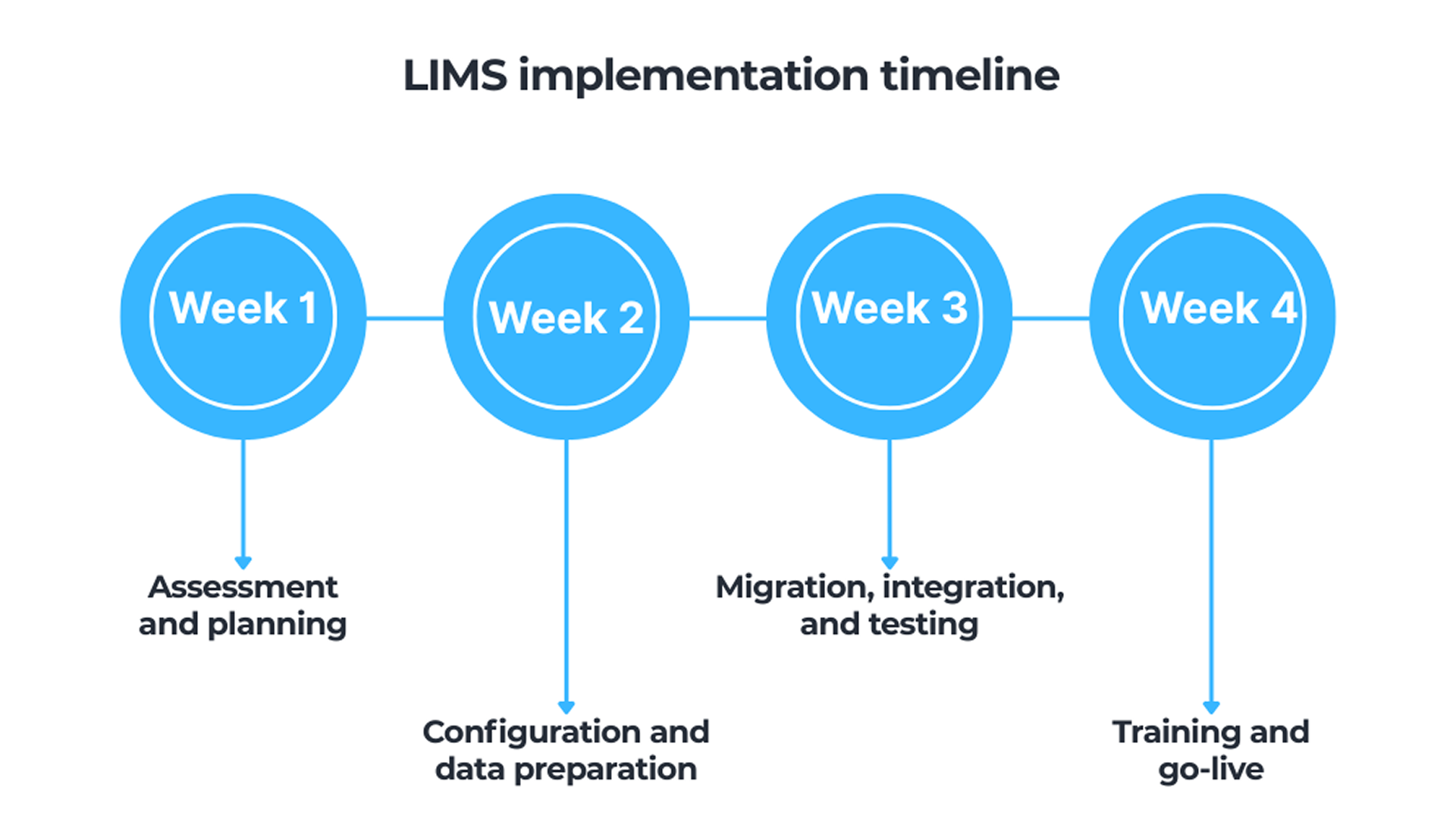
Labs with 30+ users, multiple instrument integrations, or significant amounts of data to migrate should plan for a longer runway. But for most labs, a month is realistic.
When the process is covered, it’s time to put some numbers on it.
We’ll show you three 1LIMS implementations. We don’t know how other vendors do it, but with 1LIMS, the implementation (or setup) cost covers:
Meet our three labs:
One of our clients is a small service laboratory in Canada focused on the food industry. The lab operates with 3 users and processes fewer than 50 samples per day, which makes it a relatively lean setup.
Another client is a QC/QA laboratory in Belize in the food and beverage sector. This lab has 10 users and handles more than 50 samples per day. Compared with a service lab, the workflows here are more standardized and focused on internal quality control.
A third client is a QC laboratory at an automotive manufacturer in Germany. This lab works with 30 users and processes more than 15 samples per day in an early scaling phase. In this case, the challenge is less about raw sample volume and more about the structure of the operation: more users, more defined roles, and more coordination.
Those are the setup costs. But once your LIMS is live, you'll also pay subscription fees. We won't go deep on that here, but to give you a better picture, here's what each lab paid in its first year for setup and subscription.
Keep in mind: the totals above cover setup and subscription, but depending on your situation, a few extras can add to the bill. Extra integrations are billed separately, as is ongoing support after go-live. And if you work in a regulated industry that requires GAMP 5 validation, the budget for that can add anywhere from a few thousand to €10,000+.
LIMS implementation cost is a reflection of your lab's complexity. The more users, workflows, and integrations you bring to the table, the more setup work is involved. That’s why it’s important to find the right vendor. Some systems try to do it all and charge you for all of it too.
With 1LIMS, you're not paying for what you'll never touch. You get fast implementation, customizable workflows, and measurable ROI.
Here's where most labs land in their first year, based on our projects:
LIMS pricing can feel uncertain at first, but once you understand what drives the cost, it becomes easier to plan.

Privacy is important to us, so you have the option of disabling certain types of storage that may not be necessary for the basic functioning of the website. Blocking categories may impact your experience on the website. More information