48% of QA/QC labs now rank data integrity as their top priority for the year ahead. Makes sense, as most test results still travel through paper, Excel, and a manual retype or two before they reach a final report. But every one of those stops is a chance for the trail to break. In this article, you’ll find out what auditors expect from your data, where manual transfers create the most risk, and how a connected LIMS fixes it.

Ask a lab team if they're digital, and the answer is usually "yes." They've got a LIMS, instrument software, and only a few Excel files hanging around out of habit. But ask how test results can be traced from the instrument to the final report without someone copying it along the way... and suddenly nobody's so sure.
That’s the test of data integrity. A lab can own every tool on the market and still have gaps between them. But labs are catching on. According to our 2026 State of Lab Digitalization Report, 48% of QA/QC labs now rank data integrity and compliance as their biggest priority for the coming year.

There’s a good reason for that. A data integrity issue can delay an audit or leave you unable to prove that a reported result is the same one your instrument produced. In regulated industries, that's enough to turn a routine inspection into a costly investigation.
In this guide, we'll explain what laboratory data integrity means, where it breaks, and why the biggest risk is the manual movement of data between disconnected systems. We'll also look at how a LIMS closes those gaps before an auditor has the chance to find them.

Data integrity means your data is complete, accurate, consistent, and traceable from the moment it's created to the moment someone uses it. And any change must leave a clear record.
Different standards apply depending on your industry, location, and customers. For food and beverage labs in Switzerland and the EU, these frameworks lay out what you need to prove about your data.
→ ISO/IEC 17025. Most food and beverage QC labs work under ISO/IEC 17025. While the standard covers more than data integrity, that's one of its central themes. Auditors want to see a clear trail behind every result. They check that labs identify samples correctly, control records, document changes, and trace results back to their source. In other words, you need to show not just what happened, but how it happened.
→ HACCP and ISO 22000 sit one level up, at the production and food-safety-management layer. They require businesses to keep complete records that prove critical food safety checks were carried out as planned. In an F&B lab, it covers logs for temperature, pH, allergens, sanitation, and more. If an inspector asks how you know a product was safe to release, you need to be able to produce those records and confirm they can be trusted.
→ EU General Food Law (Regulation 178/2002) is the traceability backbone for anything sold into the EU market. In practice, you need to answer two questions for any product: what went into it, and where it ended up. If one batch of raw material feeds into three finished products, you should be able to name all three. If one of those products ships to five customers, you should be able to name them, too. And those answers should be ready the moment an authority asks.
→ Swiss food law, enforced through the FSVO/OSAV, mirrors that EU traceability standard and adds a documented self-monitoring obligation. Businesses should monitor their own processes continuously and keep records that demonstrate those checks took place.
→ GDPR applies the moment your lab records touch personal data. And yes, an analyst's name in an audit trail counts. Keep the data accurate, control who can access it, and track every change. It’s the same principles as everywhere else, just with a data-privacy lens.
→ GxP, 21 CFR Part 11, and Annex 11 come into play for labs supplying pharma or operating under GxP-adjacent quality systems. These are the strictest data-integrity rules in this list. Electronic records and signatures have to be attributable, legible, contemporaneous, original, and accurate (often shortened to ALCOA), backed by a complete, tamper-evident audit trail.
→ The FAIR data principles are a set of guidelines for managing scientific data. They ask that your data be findable, accessible, interoperable, and reusable, rather than locked in a spreadsheet only one person on your team knows how to open. FAIR matters less for tomorrow's audit and more for whether your lab can reuse its own data next year, or run any kind of analytics or AI on top of it at all.
Here's the same set as a quick reference.
Call it ISO, HACCP, or GDPR, they all expect you to prove the same four things about your data.
Whatever framework brought an auditor through your doors, here's what they're checking:
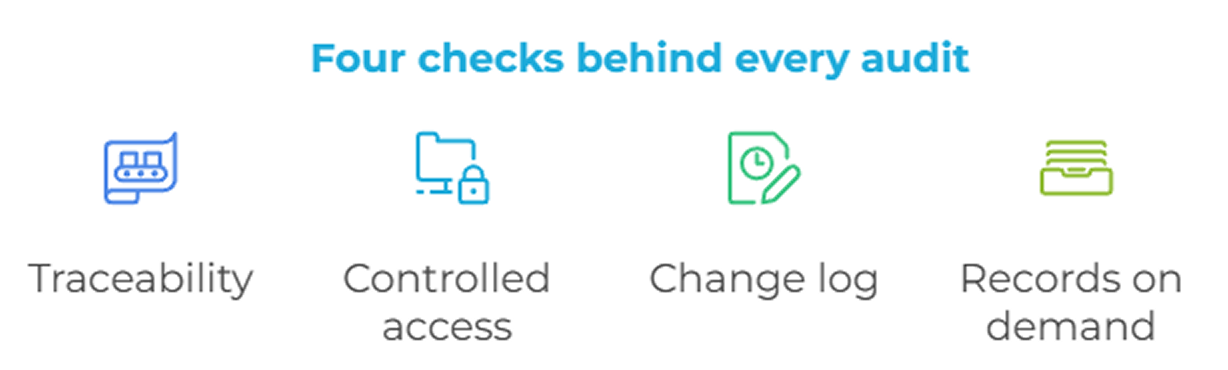
Look closely, and none of those four checks are about which software you own. They check what happens to a result in between.
Labs often treat data integrity as something you switch on with the right settings. Add the right tools, and the data should stay safe. Our report of 110 QA/QC labs tells a different story.
Only 1 in 10 labs have their instruments and software fully integrated. And buying a LIMS doesn't close that gap on its own: 2 in 3 labs with one deal with integration gaps after investing in it. Someone still has to carry data from instrument to paper, from paper into Excel, from Excel into whatever's next. And a number that travels that far might pick up a typo or two along the way.
It's no surprise, then, that roughly half of labs rely on Excel to connect the tools they already own. Burkhard Schäfer, lead architect of the AnIML data standard, sees this disconnect between systems as the root of the problem:

It turns out, labs have invested in digital tools, yet critical data still depends on human handoffs to transfer between them. And wherever data depends on manual transfers, integrity is at risk.
Data integrity usually slips through the routine handoffs that move results from one system to another. In a typical lab, that plays out like this.
❌ The manual way: an instrument produces a result, and someone writes it on paper. Later, someone else, or the same person, in a rush, types it into Excel. That number then gets copied again into a report, an email, or a second spreadsheet. Three hand-offs, three chances to lose the thread. And at the end of it, there's no record of who touched the number at any of those stages, or when.
Now picture the same result, minus the relay race.
✔️ The LIMS way: the instrument's result is captured directly into the system the moment it's produced. Nobody writes it down first or re-types it into a spreadsheet. It moves from instrument to record to report as the same number, the whole way through. And every step it takes is logged automatically, with a name and a timestamp attached.
Here's the same contrast, mapped point by point.
Looking at this breakdown, the fixes sound straightforward. Connect your systems, remove manual handoffs, and let data move automatically. But does it work in a real laboratory?
Here are two F&B companies that replaced fragmented workflows with connected ones, and the results they saw.
Zweifel Chips & Snacks AG, the biggest snack producer in Switzerland, ran quality control on paper logs and Excel. Over time, that turned into lost samples and slower workflows. When a test result didn't add up, there was no clean way to trace it back to where it came from.
Zweifel Chips & Snacks AG needed a system that could track a sample from start to finish, and picked 1LIMS. After moving to it, the lab centralized its data and introduced a sample labeling system, with test plans and audit trails. Lost samples dropped to zero, while traceability came with it.

Micarna Group, part of Migros Industry, is Switzerland's leading producer of meat, poultry, fish, egg, and seafood. Twenty-three stakeholders across the business submit samples for testing every day. The lab used to spend three to five hours each morning working through that intake. They logged samples by hand and fielded calls to check if needed. To fix that, Micarna moved to 1LIMS.
Samples now move through on QR-code labels, and intake that ran until lunch now wraps up in two hours. Today, the lab handles 50% more samples and walks into audits with every record already in place.

At first glance, these stories are about fewer lost samples and faster workflows. Indeed, both labs removed the manual handoffs that put data integrity at risk. 1LIMS here acts as the operating layer where sample data, workflows, and quality records stay connected from start to finish. Break that chain, and the consequences don't stop at the laboratory. You risk a failed audit or a customer who leaves and doesn't come back.
And there’s another reason this connection matters. The same connected data that protects you during an audit is the data your business will rely on for automation and AI in the years ahead.
If your data lives in silos that don't talk to each other, you can't meet next year's standards. And you definitely can't run AI on top of it.
The industry is already moving in this direction. Open standards like SiLA and AnIML are designed to help lab data transfer between systems and stay trustworthy once it gets there. As Burkhard Schäfer points out, laboratory instruments and software rarely speak the same language, so labs have to connect the dots on their own.
Patrick Courtney, a Board Member at SiLA, makes a similar observation. Buying software is only the beginning. The value comes when the systems can exchange data without manual work in between.

You can't run AI on data that lives separately. And if AI is part of your plans, and for most labs it is, your data needs to be ready.
Every lab has a data trail. The question is how much of it still relies on manual steps. Want to know where your own gaps are? Run our LabCheck, a hands-on audit that walks through your lab's actual workflows and maps where data moves by hand.
Privacy is important to us, so you have the option of disabling certain types of storage that may not be necessary for the basic functioning of the website. Blocking categories may impact your experience on the website. More information