Learn how to choose a LIMS that fits your lab.
Scattered files and formulas that break when someone micklicks or sneezes? Every analytical lab manager knows the Excel problem because they've lived it. So when leadership approves the budget for a LIMS, it feels like the nightmare is over.
It isn't. Because there's something worse than Excel. It’s a LIMS that doesn't fit your lab.
When you first see the LIMS cost, you tell yourself: “Fine, this investment will help us save resources long-term.” Then, implementation stretches into months. And after it goes live, your team realizes the workflow doesn’t fit. People start creating side processes and at one point someone says, “let’s just track this part in Excel.”
At this moment, the “wrong LIMS” cost shows up. Your team is double-entering data, and the system that was supposed to simplify batch release starts making it harder.
As a result, you’re paying for a LIMS and still working like you don’t have one.

Why does it happen?
Most analytical lab teams start with software before they take a clear look at their own workflows. By the time they realize the fit is wrong, the money is already spent.
Before choosing any system, we recommend one step: a LabCheck workshop from our specialists. It’s an off-site or remote visit to your lab where we take a deep dive into your operations. We map your QC processes, quantify hidden inefficiencies, and build a KPI-driven roadmap using Lean Six Sigma methods. It helps to understand whether LIMS is the right choice to improve your lab operations.
A poultry producer discovered potential savings of up to CHF 15,400 annually. Here's how
Frifag Märwil AG is a premium producer of high-quality meat covering all stages of meat production. Before moving ahead with any LIMS, we ran a LabCheck first. The workshop found that quality data management was consuming 32% of a lab employee's total working time, equivalent to CHF 22,400 in annual costs. By digitalizing QA workflows with 1LIMS, that load could drop to 10%. Based on these findings, we built an implementation plan to reduce manual workload and deliver measurable ROI.

A Swiss packaging manufacturer with plants across Europe reduces quality analysis costs by 45% with 1LIMS
One of our clients, Model AG, managed their quality control lab using a mix of SAP, Access, Excel, and scanned PDFs. We didn’t jump into LIMS software right away. We took a step back and ran a LabCheck to understand whether digitalization would make sense. It proved it would.
The assessment showed that Model AG could cut errors by 78%, increase sample throughput by 31%, and reduce quality analysis costs by 45%. With that clarity, we developed a tailored implementation roadmap to roll out a customized LIMS and digitize their laboratory operations.

Not every lab will see the exact same numbers, but the principle is the same. A LIMS only pays off when it fits.
According to Reddit forums, the biggest mistake an analytical lab can make is to choose a vendor who doesn’t understand their lab type.


But that’s usually not the only pitfall. Here are some more👇
❗Falling for a polished demo
Vendors show ideal workflows with perfect data. But your lab doesn’t run on perfect data.
❗Skipping deep workflow analysis
Labs often jump into vendor selection before mapping their own processes.
❗Prioritizing features over workflows
If the system doesn’t match your processes, you’ll have to fight it every day.
❗Trying to build the “perfect system” from day one
Many projects fail because labs try to implement everything at once when they should start with core workflows.
❗Not involving the people who use it
When decisions are made without lab staff input, key workflow details get missed.
Luckily, most of these mistakes can be avoided if you ask the right questions early enough.
If any of these made you pause, that's the right signal to slow down. We’ve created a LIMS buyer’s guide to help you make it right.
By now, you know the risks and decision criteria. So here's how the most popular manufacturing LIMS platforms stack up against those criteria, including ours.
1LIMS
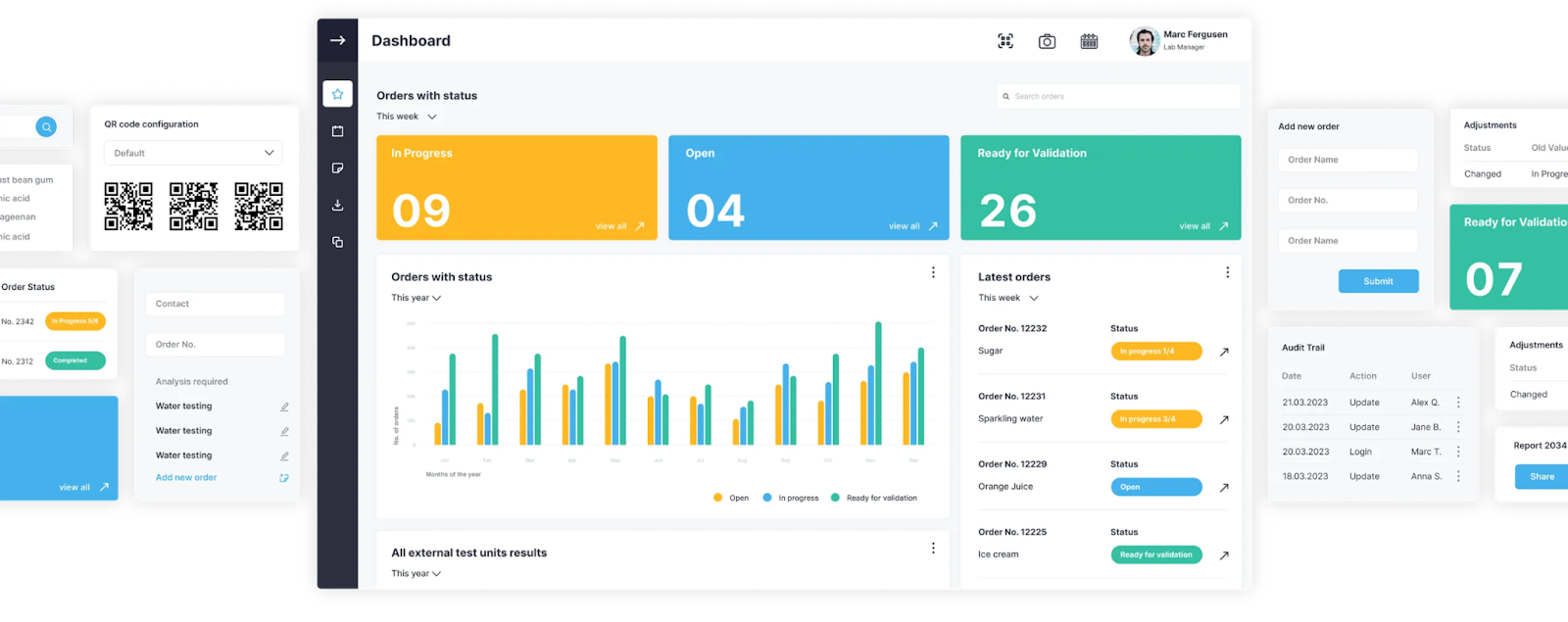
1LIMS is designed for manufacturing QC labs looking to replace Excel, paper protocols, and outdated databases.
Best for: fast deployment, QC workflow automation, clear ROI
Trade-off: not built for rigid enterprise IT structures
Implementation: ~1–3 months, often ~30 days
Pricing: €5,500–€23,000 setup, €400–€1,700/month

SampleManager
SampleManager helps regulated, high-volume QC labs manage and control the full release process.
Best for: enterprise batch release and SAP QC
Trade-off: heavy, long implementation
Implementation: 6–18 months
Pricing: quote-based

LabWare
LabWare is a flexible enterprise-grade LIMS that can adapt to complex QC and manufacturing workflows.
Best for: complex QC workflows that require deep configurability
Trade-off: setup and maintenance complexity
Implementation: several months to >1 year
Pricing: quote-based

STARLIMS
STARLIMS is a unified enterprise informatics platform that goes beyond a traditional LIMS, integrating ELN, SDMS, advanced analytics, and mobile access.
Best for: multi-site, compliance-heavy environments
Trade-off: implementation can take significant time and resources
Implementation: several months
Pricing: quote-based
There’s no universal winner. Only better or worse fit for your analytical lab. And the difference between them shows up on your production floor. So choose before it costs you.
P.S. Want to dive deeper?
📖 We’ve analyzed the 7 top manufacturing LIMS platforms to give you a full picture of what a good LIMS solution looks like.
📌 And here's what makes 1LIMS different from other platforms.
🔍 Curious about our approach? Here’s a deeper look at our Lean Six methodology.
▶️ Prefer video? Visit our YouTube channel to learn more about how 1LIMS can transform your lab.
📊 We’re also running the State of Lab Digitalization Report, so you’re welcome to participate. It takes only 4 minutes.
Happy & safe lab work!
❤️ Greetings,
1LIMS Team
Privacy is important to us, so you have the option of disabling certain types of storage that may not be necessary for the basic functioning of the website. Blocking categories may impact your experience on the website. More information