If you ask lab teams whether they're digital, the answer is usually yes. And it will be true in most cases.
In our 2026 State of Lab Digitalization Report, 95% of QA/QC labs revealed they use digital tools. It might be a LIMS, instrument software, an ELN, or all three.
Great result, but another question breaks everything: Does your data move between those systems automatically?
For most labs, the answer is still no.
Among 110 QA/QC labs across 7 industries, half of them in food & beverage, only 1 in 10 described their setup as fully integrated. Everyone else was somewhere in the middle.
Or not connected at all.
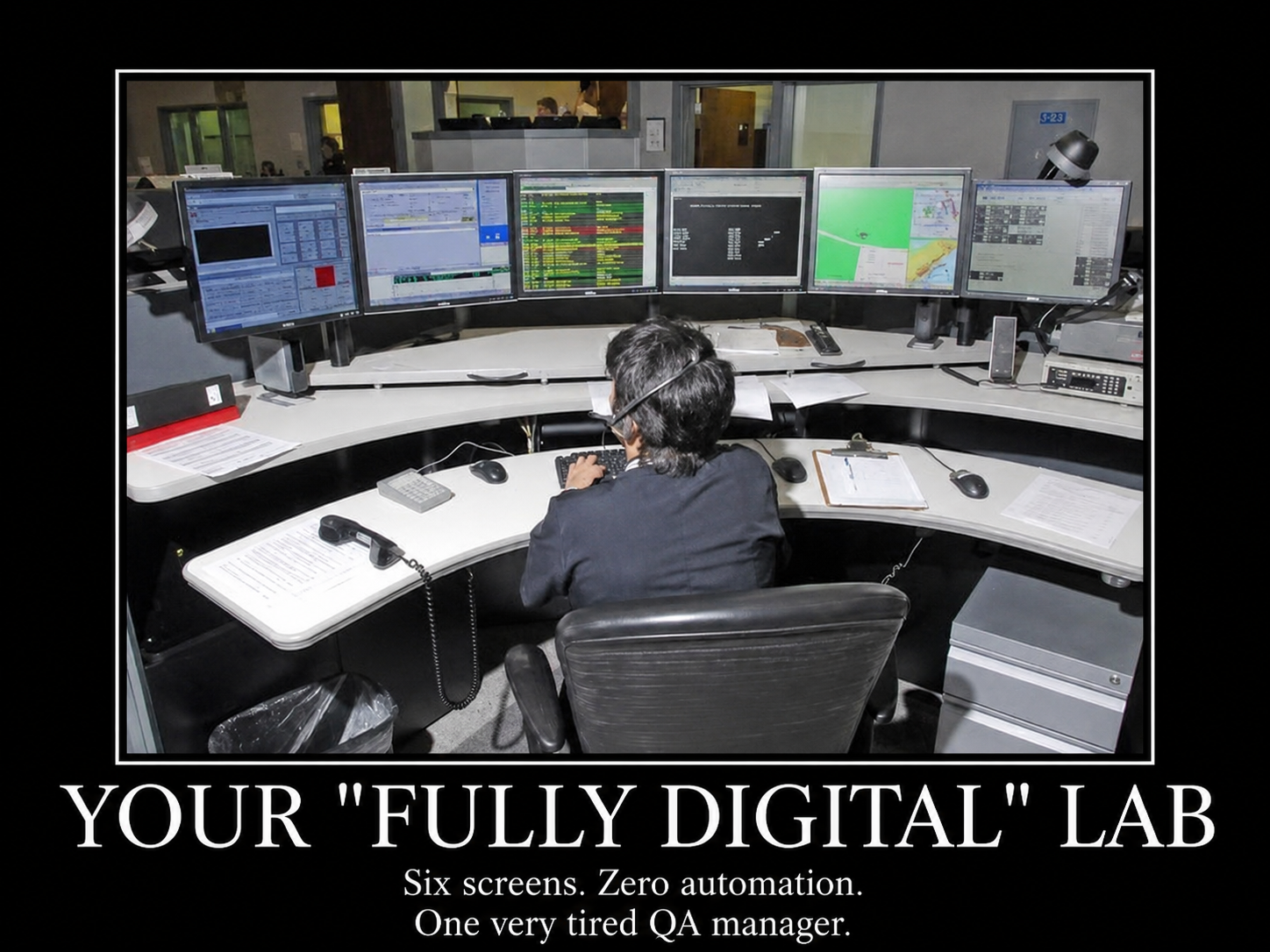
Welcome to 'mostly digital' labs
Here’s what their workflow looks like:
🧪A test result leaves the instrument → 📊it enters the LIMS →📄it needs to reach the weekly report → 📥someone exports it to Excel.
📊 Production data makes the same trip, from the ERP.
📄QA has their own spreadsheet for the parts that don't connect.
And when the auditor asks for a full traceability record, someone clears their afternoon and has to pull it together manually.
That afternoon happens in most growing labs.
Our report found that QC laboratories aren't after headcount cuts or cost savings (those rank last). They want quality, speed, and less compliance risk. That’s why they invest in digital tools and connect whatever parts of the workflow they can. But since those connections don’t cover the entire workflow, labs stay stuck in hybrid mode.

The real cost of disconnected tools
Someone always pays for that space between the LIMS, the ERP, and the spreadsheet. Usually, it's your lab because:
❌ Every manual data transfer is a chance for an error.
❌ Every hour spent pulling reports together is an hour not spent on actual lab work.
❌ Every disconnected system is a gap an auditor can find before you do.
❌ Every spreadsheet outside the LIMS is a record someone can question, including you.
It might seem like addressing all these requires fundamental changes. It doesn't. Most of it can be resolved without starting over.
The problem is smaller than you think
Growing labs assume integration work means another long IT project, sometimes 12 months or more. So they leave things as they are.
But the way out is simpler. Map where the data breaks and fix those connections one at a time. Our client started there.
➡️ Case in point: Frifag Märwil found CHF 15,400 in savings with LabCheck

Frifag Märwil AG is a Swiss poultry producer that oversees the entire production chain from animal feeding to delivery. Their ERP handled purchasing and warehouse, but quality management ran on a patchwork of Excel files and self-built forms. One full-time employee spent 32% of their time just managing quality data.
Frifag knew they needed to change. But first, they wanted to understand what was broken. So they ran a LabCheck, a structured pre-implementation audit that maps a lab's current workflows and identifies opportunities for improvements. The assessment revealed that with 1LIMS, Frifag could reduce quality data workload from 32% to 10% and recover up to CHF 15,400 a year.
Need more details? Read the full case study →
If your lab's data isn't as connected as it should be, change is probably overdue. But before you commit to anything, you need to understand how your current setup works and where it doesn't.

Don’t rush into new systems
More systems won't save a broken flow. Find out what's broken first, then decide what to add. You can do that with LabCheck. We come in, trace how you manage quality in the lab, identify where the gaps are, and give you an action plan for what to do next.
If your data doesn't flow yet, let's find out why.
P.S. Want to dive deeper? Check these out:
📊 2026 State of Lab Digitalization Report, 110 labs surveyed.
See how laboratories approach digitalization and where they get stuck.
🔗 LIS vs LIMS: What's the difference?
Before you add another tool, know what each one is for. A clear breakdown of each system and its place in a connected lab.
🔗 How to Integrate LIMS with ERP
Your ERP and LIMS serve different purposes and often speak different languages. Learn how to connect them without creating more manual work.
▶️ Analytical Lab Digitalization Failed? The Truth About LIMS & Data.
Why do 8 in 10 labs have a LIMS, yet only 11% have their systems connected? This video unpacks the reality behind lab digitalization efforts.
Happy & safe lab work!
❤️ Greetings,
1LIMS Team
Privacy is important to us, so you have the option of disabling certain types of storage that may not be necessary for the basic functioning of the website. Blocking categories may impact your experience on the website. More information