If the lab industry had a buzzword of the decade, "digitalization" would win it. But what does a digital lab actually look like in 2026? We decided to find out.

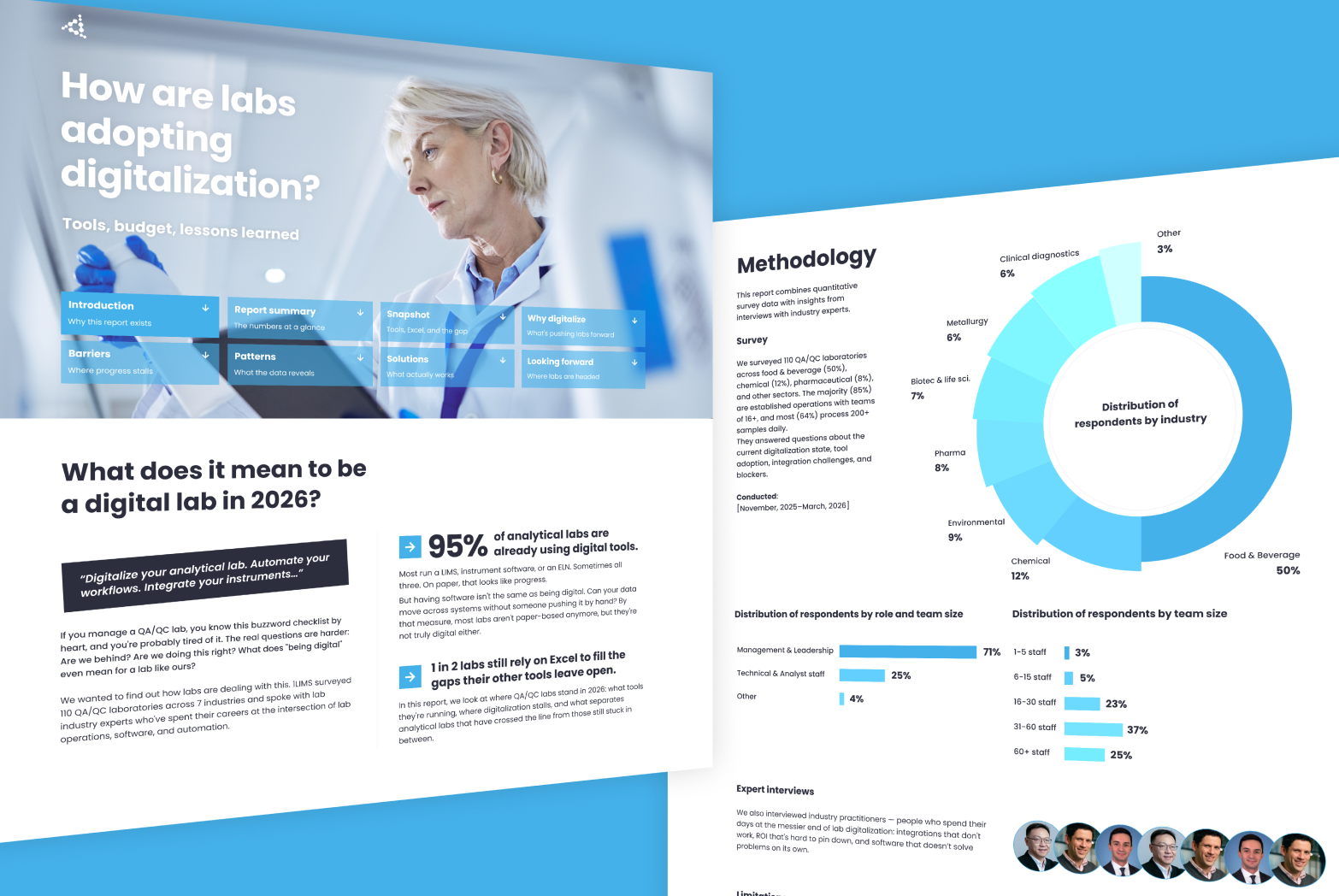
At 1LIMS, we work with QA/QC labs every day. Most of them have a LIMS, instrument software, sometimes an ELN added. On paper, that's digital. But someone is still typing test results in by hand, and lab data still lives in spreadsheets.
We wanted to measure how common it really was. So we ran our first report, surveying 110 QA/QC laboratories across food & beverage, chemical, pharmaceutical and other sectors.
First, thank you to everyone who participated. This report exists because of you.
Going through the responses, a few findings kept standing out. They all point at the same underlying question: What does 'being digital' actually mean for a lab, and what gets in the way?
It depends how you look at it. 95% of labs we surveyed use digital tools. By that measure, you'd think the answer is yes. But when we asked labs to rate where they stand, only 1 in 5 put themselves in the "fully digital" camp: instruments and software connected, data flowing without anyone pushing it. The other 80% landed somewhere in the middle, mostly digital, meaning tools that are there but don't connect.

Our take: The lab industry has been measuring the wrong thing. "Do you have [any lab software]?" became a stand-in for "are you digital?", and those aren't the same question. Software is a tool, meanwhile being digital means your data can move through your systems without someone carrying it from one place to the other.
Because having tools and having them connected are two different things. Being digital, as we established, is about the second. Only 1 in 10 labs in our survey have their instruments and software fully connected.
A typical lab runs a titrator from one company, a mass spectrometer from another, a balance from a third. Getting results out of all of them and into one place? None of that happens automatically. What stays, then? Excel, of course. 54% of labs still use it for day-to-day work. Even among analytical labs that already have a LIMS, 1 in 3 still open Excel daily, and 1 in 5 crunch numbers there by hand.

Our take: Labs call Excel 'the glue', and honestly, it fits too well. When results come off an instrument with nowhere to go automatically, they end up in Excel first. Closing that gap means building integrations, and most analytical labs haven't gotten there yet.
When we asked labs what's preventing them from automating further, we expected the budget to come up. It came last, cited by just 7% of respondents. What came up most instead were regulatory constraints, staff resistance, and difficulty connecting systems.
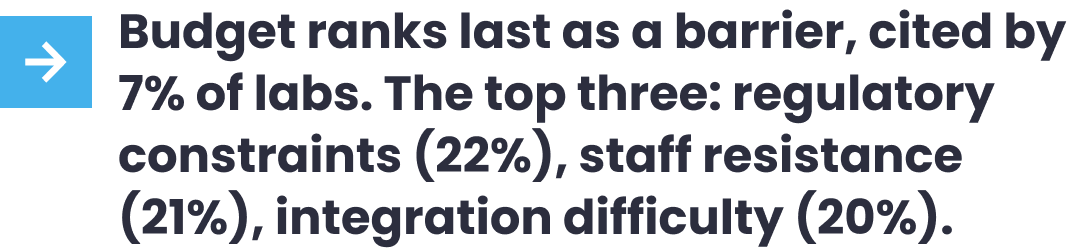
Our take: The obstacles most analytical labs face are people and process problems. Regulatory pressure that makes change hard to justify. Staff who've worked the same way for years and need convincing. Systems that need connecting. Budget approval moves past all of these without touching them. The starting point: work out what’s holding your lab back and go from there. If it's staff resistance, for example, a small pilot with the people who want it to work will help.
If you're managing a QA/QC lab, a lot of this probably sounds familiar. Most analytical labs we surveyed have invested time and money into digitalization. But getting the data to actually flow between systems is the part most are still figuring out, and it's a more solvable problem than it might feel like from the inside.
Our full report goes deeper, including what lab industry experts think labs are consistently getting wrong, and what the data says about where labs are headed in the next 12 months (AI is on the horizon, sure, but there's a catch).
We hope you find it useful, and if you have questions, we're happy to talk.


Privacy is important to us, so you have the option of disabling certain types of storage that may not be necessary for the basic functioning of the website. Blocking categories may impact your experience on the website. More information