2 in 3 labs running a LIMS report integration gaps. Most of the time, someone reads results off an instrument and types them in by hand. So why does the gap remain after you’ve implemented LIMS? The answer lies in the instrument. This article shows how to connect it to a LIMS, including two-way connections like Metrohm OMNIS. It also breaks down the potential time and cost savings for your lab.

Pick any result in your LIMS from last week. Did it travel there on its own, or did someone carry it?
For most labs, the answer is somewhere in between. The balance might talk to the LIMS, but the titrator might not. And somehow, people have to fill the gaps by hand.
How common is this? Very. For our 2026 State of Lab Digitalization Report, we surveyed 110 QA/QC labs, half of them in food and beverage. Only 1 in 10 had fully integrated instruments and software. Even among labs with a LIMS, 2 in 3 still report integration gaps.
A LIMS can take care of many things. But it can only work with the data that reaches it. In this article, we look at how instrument results can get to your LIMS hands-free.

At its simplest, LIMS instrument integration is the automatic transfer of measurement data from a laboratory instrument into the LIMS. The instrument could be a balance, titrator, pH meter, spectrometer, chromatography system, or plate reader. Each one works in its own way, but the result should reach the LIMS without anyone's help.
At first glance, plenty of labs are digital. The instruments run on their own software, and the records sit in a LIMS. The weak spot is the step between the two. If a result ever lives on a scrap of paper next to the balance, even for five minutes, the instrument and the LIMS aren't integrated.
Good lab instrument integration also doesn't stop when the result reaches the LIMS. The system should understand the instrument behind the result:
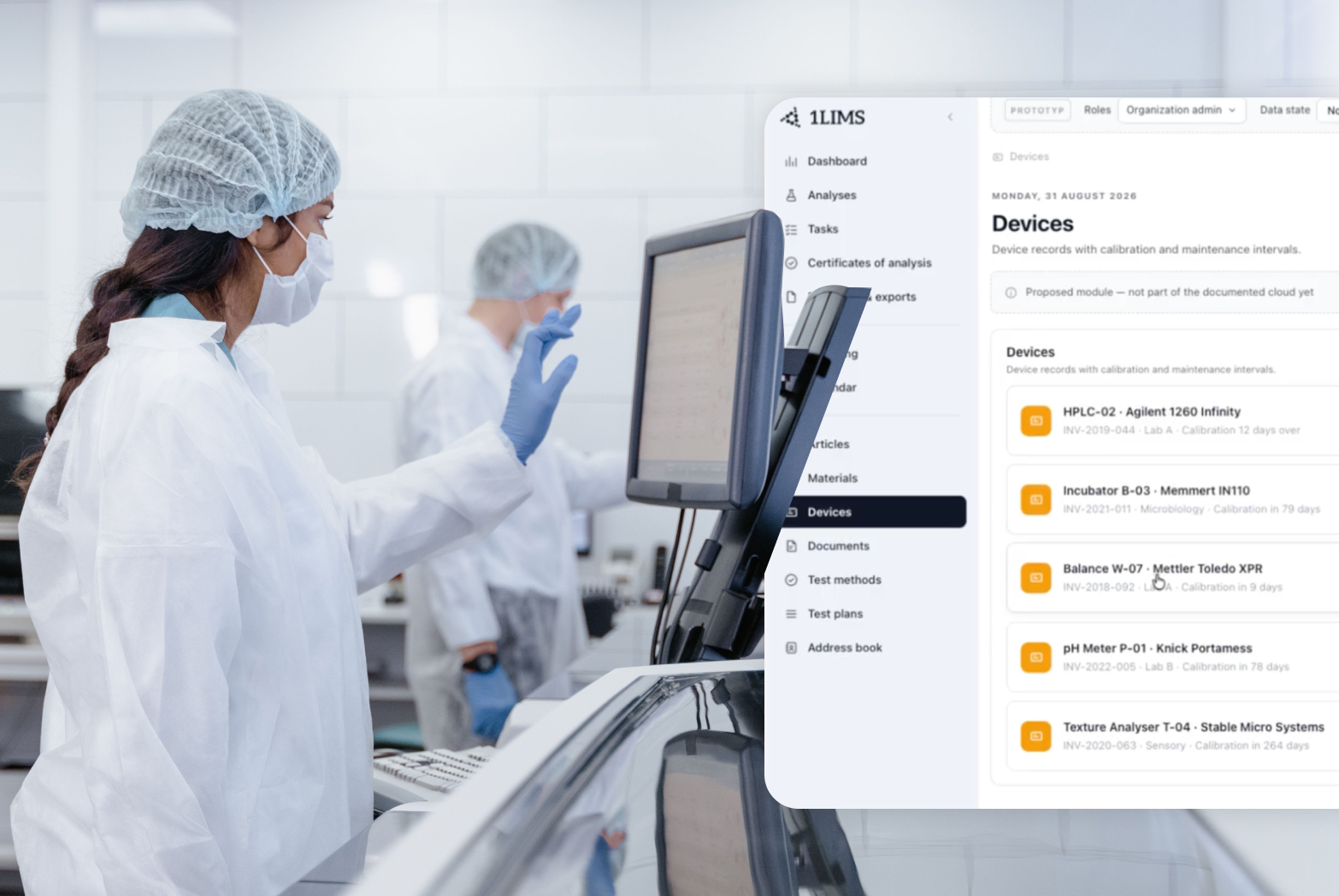
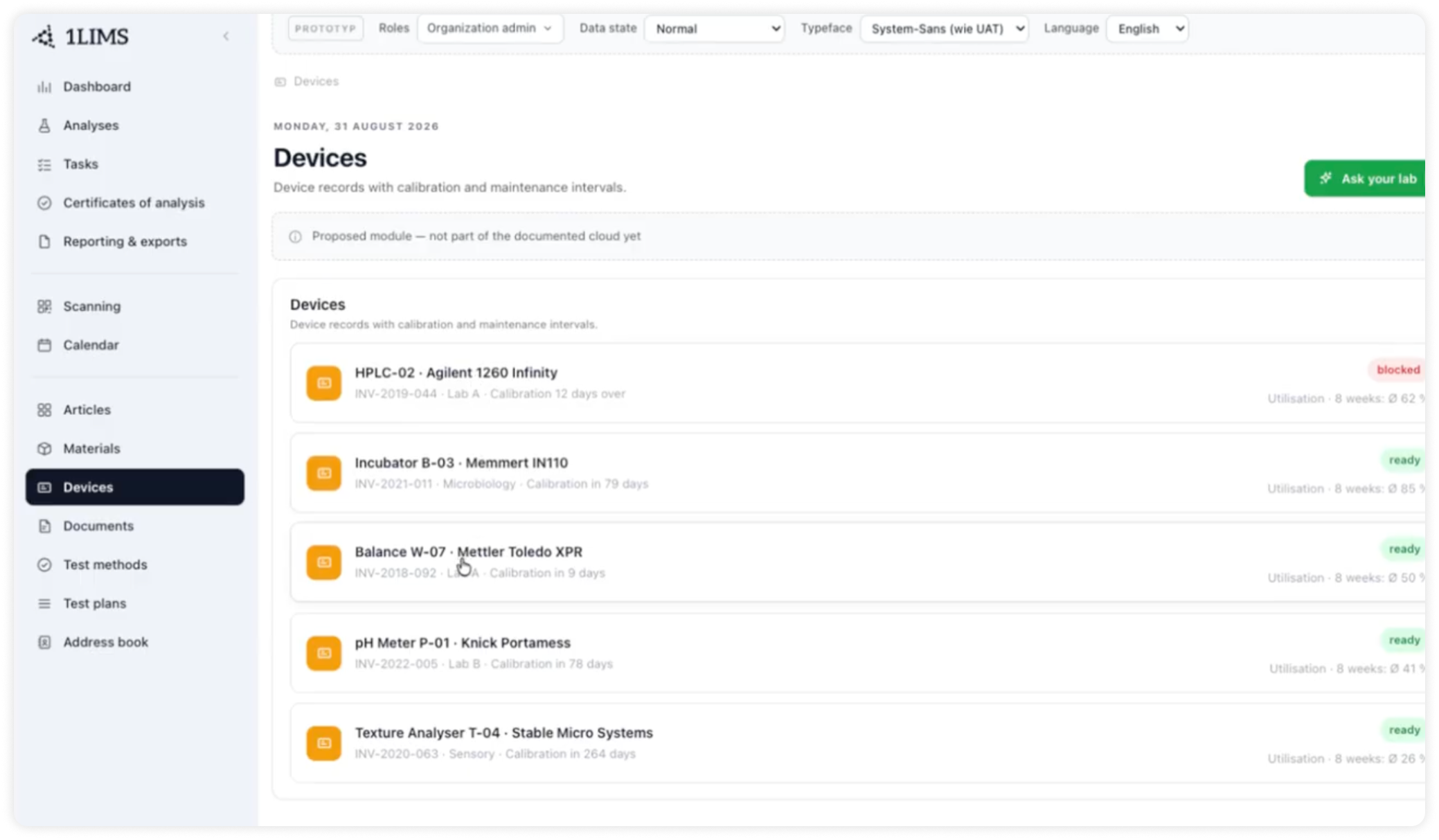
In 1LIMS, the Devices module tracks each instrument's calibration and maintenance intervals, overdue calibrations, and utilization history. If a calibration goes overdue, 1LIMS can block the instrument and stop affected tests from being planned on it.
One manual entry doesn’t look like much. Multiply it by every sample your lab handles, and the minutes pile up.
Then someone mistypes a value. They go back to the raw result, and perhaps rerun the analysis. That takes more time, more reagents, and can hold up product release. If the mistake makes it through review, the certificate can go out with the wrong number.
Inspectors also care about that trail. They need to know where a result came from and what happened to it along the way.
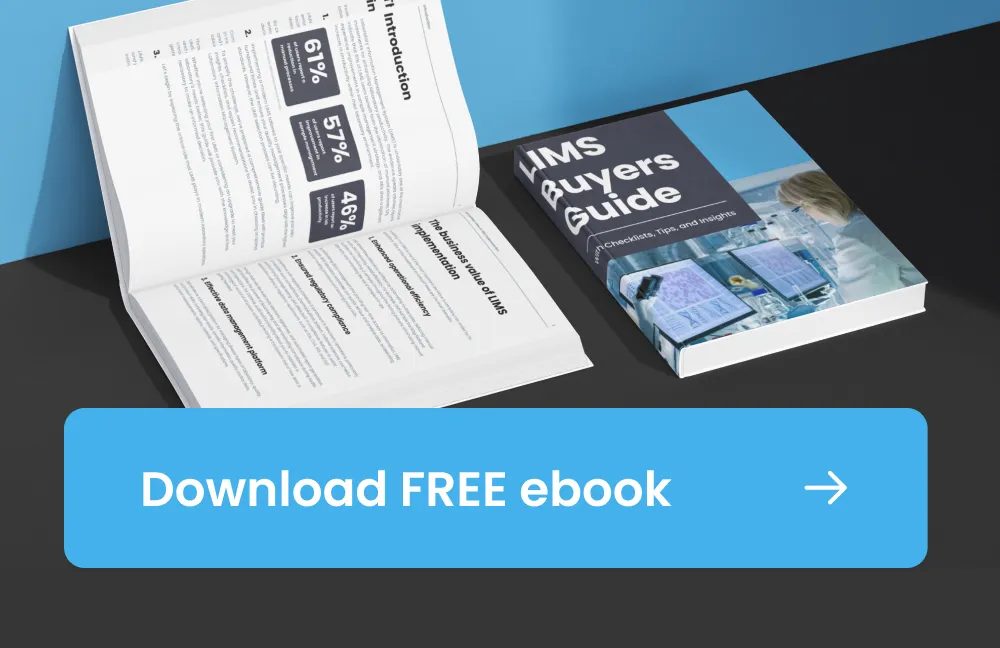
So when you evaluate a LIMS, ask early how it connects to your instruments. It's on the checklist in our LIMS Buyer's Guide, together with the other requirements to check.
If LIMS instrument connectivity matters this much, why do so many labs with a LIMS lack it?
Look around a typical analytical lab and part of the answer is right there. The titrator might come from one company, the mass spectrometer from another, and the balance from a third. Each speaks its own language. The SiLA standard helps make instrument communication more consistent, but labs have a mix of instruments that need different ways to connect. Burkhard Schäfer, lead architect of the AnIML data standard, puts it like this:

Even the best LIMS can't natively support every instrument model on the market. When a connection doesn't exist out of the box, labs fall back on the nearest available bridge: a person with a keyboard, or a spreadsheet. That’s why you don’t eliminate data silos by default because you have a LIMS. The instruments need a way to talk to it. The question is how.
For many instruments, the answer is a direct connection between the LIMS and the instrument's own software.
One way to integrate a LIMS with an instrument is through an API. Some of these connections are already built into 1LIMS, and Metrohm OMNIS is one of them.
Metrohm is a Swiss manufacturer of titration instruments. We partnered with Metrohm to connect 1LIMS directly to its OMNIS titration platform through the OMNIS Web API. This lets data move in both directions. Here’s how it works:
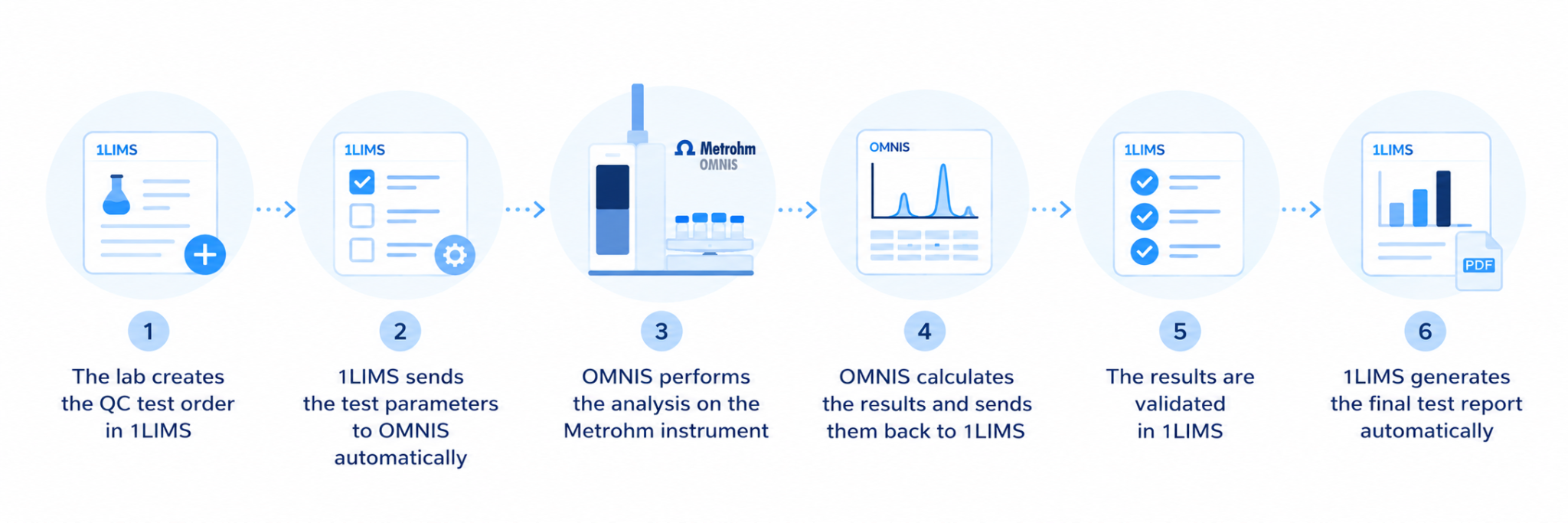
Older instruments often don’t have an API. That’s not a problem. 1LIMS can connect them through a serial interface or file transfer.
Don’t see the connection you need? We’ll work out how to connect it with you. Our team can build the integration, or, if you have developers in-house, they can use the 1LIMS RESTful API to build it themselves.
Let’s assume now the instrument can talk to your LIMS. Great. But how do you know it’s talking tomorrow?
One day, the connection might break. For example, an export format changes. The instrument runs as usual, but the results don’t reach your LIMS. If it’s not fixed in time, a lab technician starts typing the results in by hand. Hello again, sticky note.
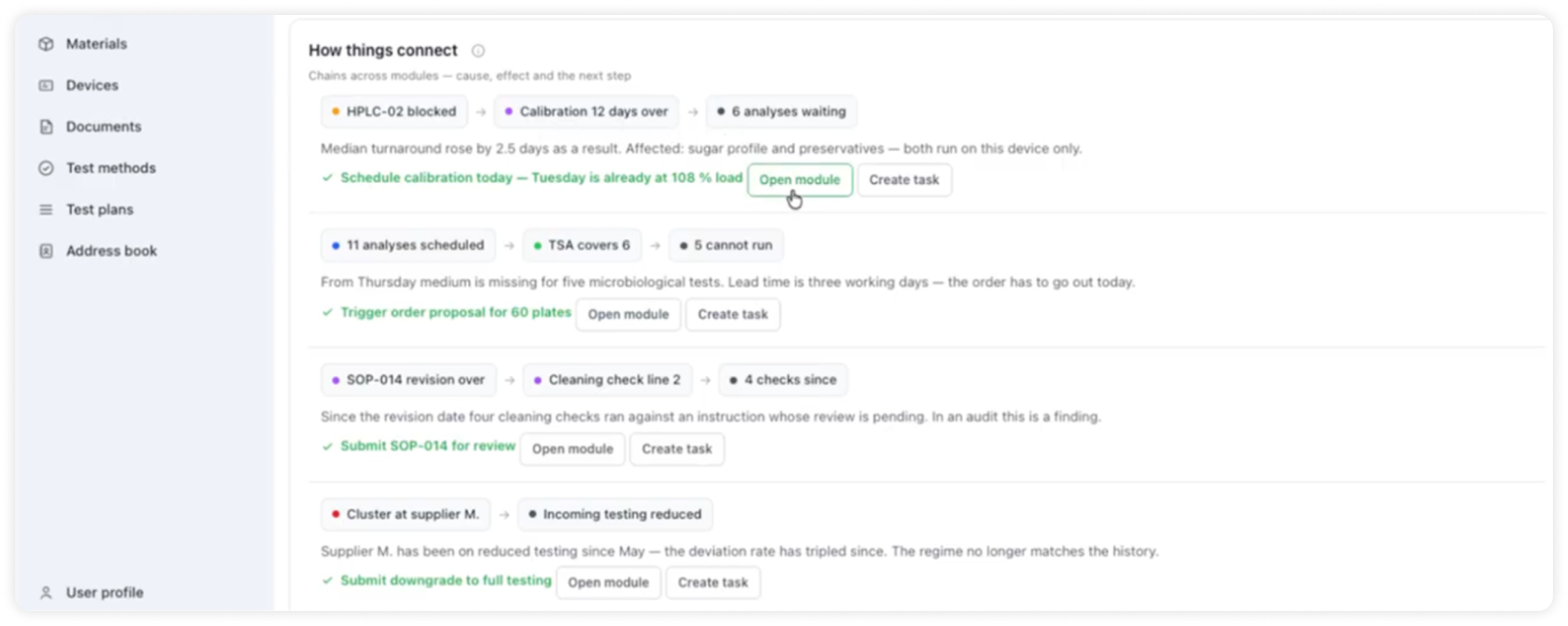
1LIMS keeps an eye on this for you. Every connected system, from instruments to SAP, MES, and external partner labs, has a live health status, so you can see at a glance whether each one is syncing. If a connection falls behind, 1LIMS marks it as delayed and alerts you.
1LIMS also shows the impact of a problem on your lab's work. Say an instrument is blocked because its calibration is overdue. 1LIMS traces the knock-on effect. It analyses waiting in the queue and turnaround time stretching by 2.5 days, for example. Then it suggests the next step and creates the task in one click. The lab sees what's stuck, and management sees what it costs.
So the data moves, and you know when it doesn’t. What does that save you? Let’s go back to Metrohm OMNIS.
We’ve modelled what the Metrohm OMNIS integration saves a lab that runs titrations every day. Here's the math.
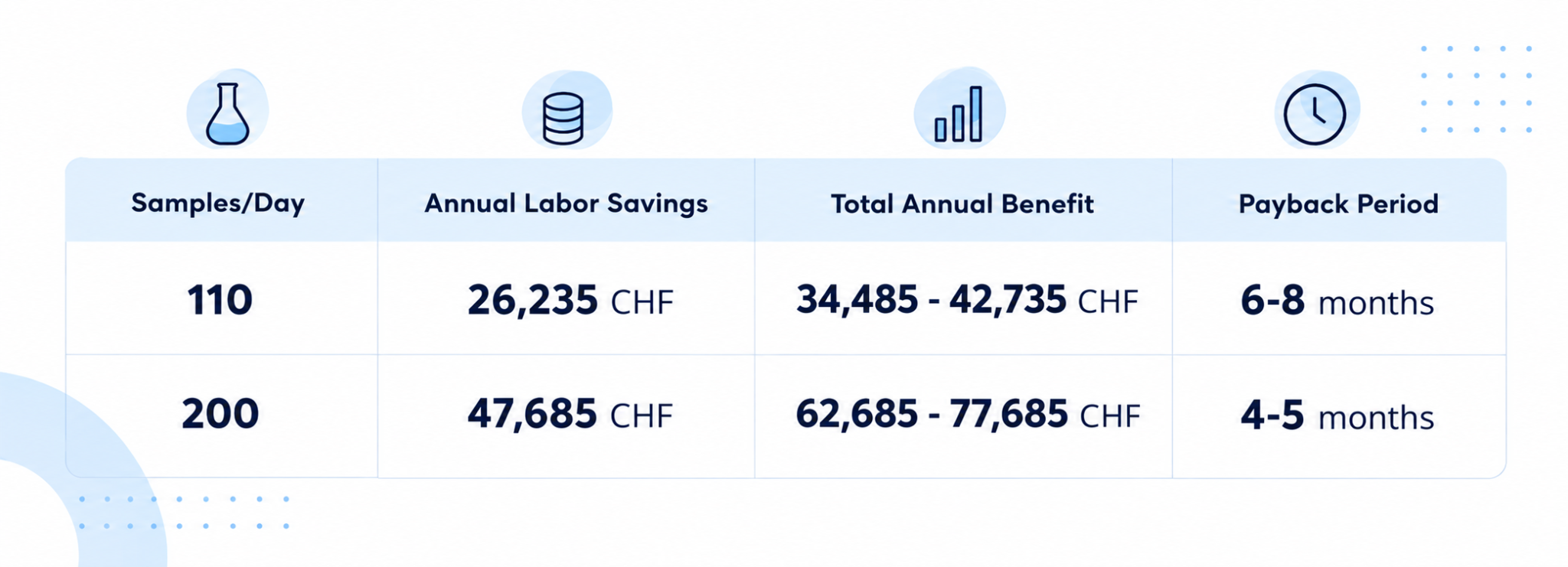
Integration saves around one minute per sample. It sounds small, but at 110 samples a day, it adds up to almost two hours of lab time every day.
Those minutes turn into money. A lab running 110 samples a day saves about CHF 26,235 (~EUR 28,000) a year in labor. At 200 samples a day, the savings rise to about CHF 47,685 (~EUR 50,000).
When results move automatically, there's nothing to mistype. Fewer wrong numbers mean fewer reruns, which saves an estimated CHF 5,000–10,000 (~EUR 5,300–10,600) a year.
Products can be released 1–2 days sooner, because results arrive the moment the test is done.
Add everything together, and the total annual benefit is about CHF 39,000 (~EUR 41,000) for a lab running 110 samples a day. For a lab running 200 samples a day, it's about CHF 70,000 (~EUR 74,000).
The integration pays for itself in about 6–8 months at 110 samples a day. The busier the lab, the faster the return: at 200 samples a day, payback takes about 4–5 months.
That’s one instrument. Now imagine the whole lab connected. Or better yet, let’s look at one that is.
Micarna, Switzerland's leading meat, poultry, and seafood producer, runs a QC lab that handles 100 to 200 samples a day with three technicians. For years, the lab relied on paper and Excel, so sorting incoming samples took the whole morning.
We implemented 1LIMS at its main site, then rolled it out to all 23 locations. Now a quick QR code scan identifies each sample, and 1LIMS imports article data from SAP automatically. The team gets through each day's incoming samples in about two hours. With less time spent on paperwork, the lab processes 50% more samples than before.

It’s only a tiny part of how we implemented 1LIMS for Micarna. Take a look at the whole story if you want to learn the rest.
Of course, the numbers above aren’t your numbers. Your lab has other instruments and sample volumes, so your savings will look different.
We can run the numbers for your lab with LabCheck. It’s a one-day workshop where we look at your lab on-site or remotely and map your processes and instruments with your team. You’ll see which connections make sense and which ones would pay back first.
Privacy is important to us, so you have the option of disabling certain types of storage that may not be necessary for the basic functioning of the website. Blocking categories may impact your experience on the website. More information