Not all LIMS are created equal. Have a look at our list of top LIMS vendors and see why the right choice starts with your lab’s workflows, size, regulatory requirements, and budget. Find a LIMS that solves today’s problems without long implementations or costly detours.


Fast turnaround times. Strict regulations. Zero tolerance for data integrity failures. Quality control (QC) labs need all three, and most managers know that LIMS is the solution.
If you pick the right one.
The wrong choice, on the other hand, can derail operations for months (or even years), consume hundreds of thousands in consulting fees, and still leave your team drowning in Excel workarounds.
1LIMS has been collaborating with manufacturing and food and beverages QC labs since 2016. We know what helps avoid the “wrong choice” trap, and it’s rarely the features highlighted in vendor demos or glossy marketing materials.
Dr. Phil Williams, a LIMS expert at LIMS4U, made the same point to us in the report: "You want a system that's configurable above all else, not just feature-rich." Put configurability at the top of your shortlist criteria. Feature-count comparisons come second.
This article evaluates top LIMS vendors based on practical criteria, like implementation speed, workflow adaptability, and pricing (because yes, money matters in 2026). But our goal is not to sell you 1LIMS. We are here to help you find the right fit faster and with fewer costly detours. Even if that fit isn't us.

If you think LIMS selection starts with vendor research, it doesn’t. It starts with understanding your own lab.
Independent practitioners agree. Gerard Ipskamp, a LIMS selection consultant with 20+ years of experience, told us for our 2026 State of Lab Digitalization Report: "Most projects fail from too much discussion about what to implement. You have to know what your processes are before the vendor is in the room."
You might believe that you know your lab, and this step wastes time. While true to some extent, can you articulate what you need in a way that filters out bad-fit vendors? The questions below will help you do that. They prevent you from evaluating systems that were never designed for your lab.
Research, QC, or clinical? Each needs fundamentally different things.
→ Research laboratories focus on discovery, experimentation, and innovation. These labs require flexible electronic lab notebooks (ELN), extensive collaboration features, protocol management capabilities, and systems that can handle unpredictable workflows.
Examples: Biotech startups, pharmaceutical R&D teams, and academic research institutions.
→ QC laboratories test raw materials, in-process samples, and finished products against established specifications. QC labs need standardized workflows with minimal variation, rapid sample throughput capabilities, automated pass/fail determinations, certificate of analysis (COA) generation, and tight integration with ERP systems.
Examples: Food and beverage manufacturers, chemical companies, and pharmaceutical production facilities.
→ Clinical laboratories process patient samples for diagnostic purposes and face some of the most stringent regulatory requirements in the industry. These labs require HIPAA compliance for patient data protection, CLIA certification support, CAP accreditation compatibility, and integration with hospital information systems (HIS) and electronic health records (EHR).
Examples: Hospitals, diagnostic centers, pathology labs.
Most LIMS platforms claim to support all types of laboratories. In practice, they usually excel at one. And struggle outside it. That’s why you should know which world you're in before you start shopping for LIMS.
Not someday. Today.
A system built for 200 users will crush a small lab with unnecessary complexity. Meanwhile, a system that works for 8 people will break under enterprise demands. That’s why your lab’s current size matters: it determines which vendors can deliver value.
Here's what that means in practical terms:
→ Small laboratories need straightforward systems that can be implemented quickly without extensive customization.
→ Mid-sized laboratories require more sophisticated functionality with multi-user access, role-based permissions, complex workflows, third-party integrations, and more.
→ Enterprise laboratories demand comprehensive enterprise-grade solutions with multi-site deployment capabilities, extensive customization options, advanced security and audit features, and dedicated support resources.
If you manage to find a perfect match here, you’ll avoid costly reimplementations in the future.
Want a deeper walkthrough of the LIMS decision process? We’ve covered it step by step in our article on how to pick the right LIMS software.
Be honest about your constraints here, because this decision is hard to reverse.
Migrating from on-premise to cloud (or vice versa) means re-implementation. It also means retraining staff, revalidating workflows, and temporarily slowing throughput. You're making a 5-7 year commitment, so get it right the first time.
Let’s start with the cloud.
→ Cloud-based LIMS is the most obvious solution for most labs. It’s faster to deploy, cheaper to run, and eliminates IT headaches. But "most labs" isn't all labs.
Do you have deal-breaker constraints that force on-premise, like government or defense requirements? If not, cloud wins. If yes, don't let a vendor talk you out of what you need.
Cloud works if:
→ On-premise LIMS remains relevant for organizations with highly regulated environments or security policies that prohibit cloud storage of sensitive data.
So, you need on-premise if:
Here’s a quick decision framework to help you navigate it.
FDA 21 CFR Part 11? ISO 17025? The system needs to be ready for audits. Already.
All LIMS vendors say they're "compliant". What they mean is "we can be made compliant with enough customization and validation". But you need a LIMS that has already been validated in your regulatory environment, with documentation ready for auditors.
For example, if you submit data to the FDA or operate under FDA oversight, you need to comply with the FDA 21 CFR Part 11. This regulation requires electronic signatures, comprehensive audit trails, system validation documentation, and controls preventing record alteration or deletion.
If you issue test reports or calibration certificates that customers rely on, you need ISO 17025 accreditation. That’s why your LIMS needs to track when equipment is due for calibration (and stop you from using it if it's overdue), document how you validated your test methods, and handle corrective actions when things go wrong.
And those are just two examples. In reality, labs deal with dozens of regulations. That’s why it helps to write down exactly which ones apply to your lab and treat them as non-negotiable.
Get clear on these questions, and vendor evaluation becomes faster and far less risky for your lab.
If you’re reviewing LIMS for food safety environments, our related article breaks down the requirements and decision criteria in more detail.
Since we don't know your specific lab constraints and how you answered the questions above, some vendors we cover may not match your needs. That's why we've structured this evaluation around the criteria that matter most:
By the end, you'll know which LIMS vendors deserve deeper evaluation and which ones you can eliminate with confidence.
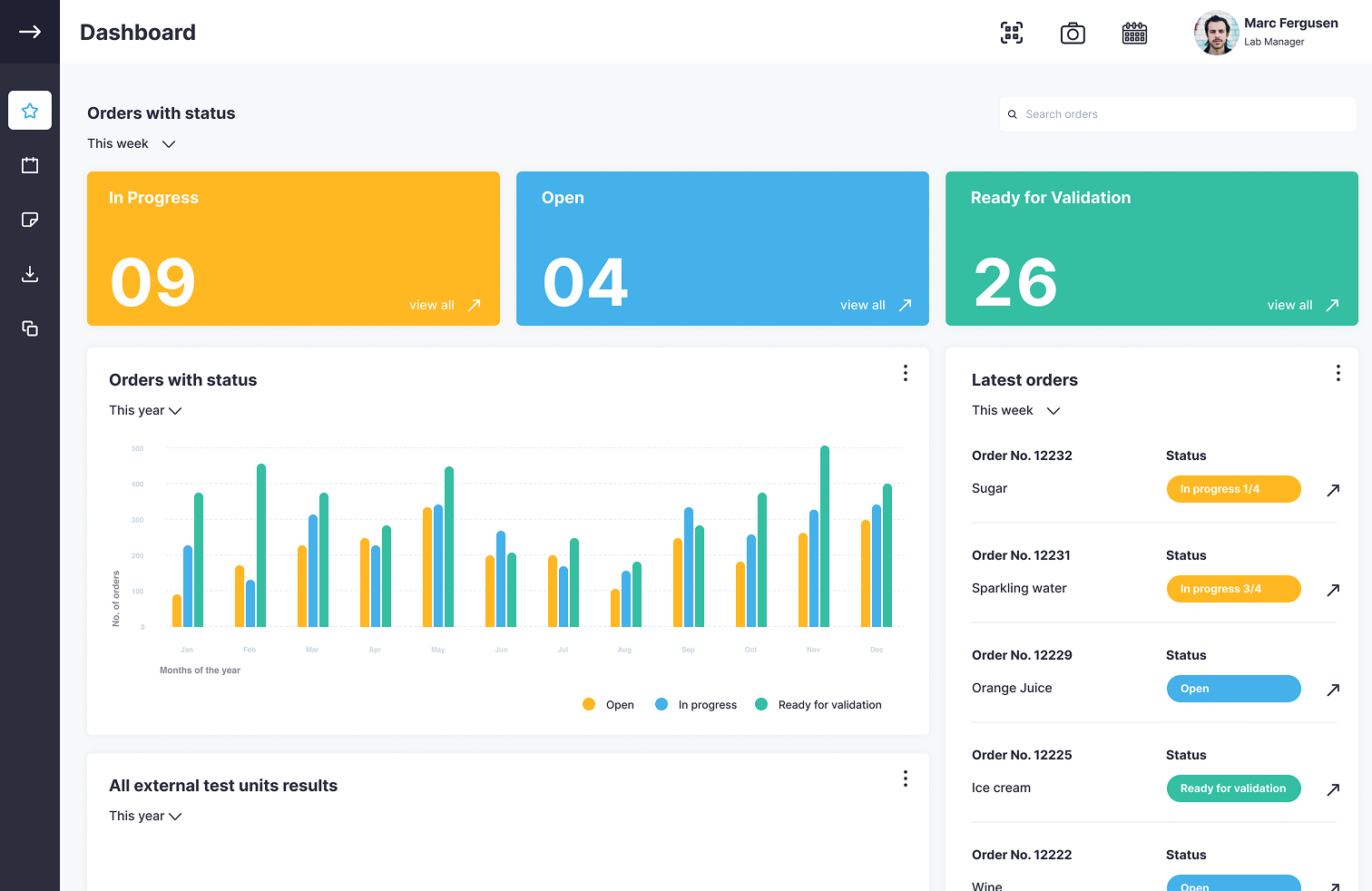
1LIMS provides a centralized system for all quality data, workflows, and reporting. Core capabilities cover order and sample management, risk-based analyses, integrated label printing with QR codes, and seamless integration with lab instruments and external laboratories.
On the lab floor, this translates into 75%+ fewer manual errors and up to a 50% reduction in QC data management workload.
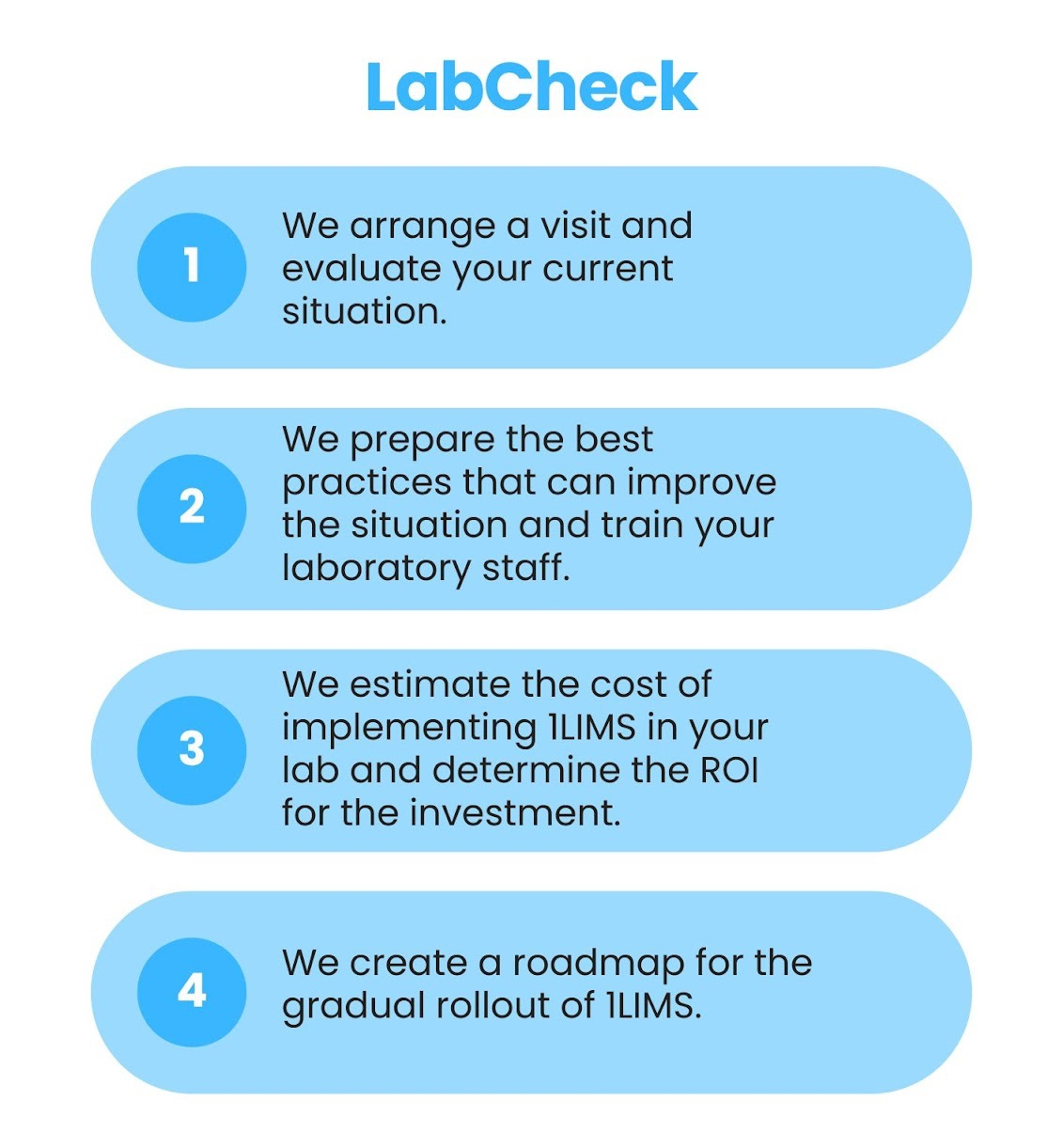
Implementation speed: For most labs we partnered with, 1LIMS was operational in 30 days. We usually start with the LabCheck, a full-day on-site evaluation of your lab that includes SIPOC analysis and Gemba Walk to understand your actual workflows. Based on the findings, we provide guidance on how to improve your lab operations.
Here’s how our LabCheck works 👇
Configurability: With 1LIMS, customization starts at the implementation stage. Test templates, user roles, approval steps, and reports are set up to reflect how work flows through your lab. We carefully migrate existing data from spreadsheets or legacy systems and make sure historical records remain usable.
Ase 1LIMS is cloud-based, there’s no infrastructure to manage on your side. Our team handles the technical setup, integrations, and validation support, while your team focuses on confirming that the system fits day-to-day operations. We provide continued support after go-live to adapt the system as your needs evolve.
Integration capabilities: 1LIMS connects to the systems your operations already depend on, like ERP and MES platforms, QMS, document management systems for SOPs and protocols, lab devices (Metrohm, Nemis), and external contract labs for outsourced testing.
If you have the technical resources, you can use the API documentation to develop custom integrations on your own. Or we can partially or fully handle custom integration projects for your needs.
Total cost of ownership: Of course, the final cost is calculated individually for each lab, but we can give you the basics to understand the full picture. With 1LIMS:
→ Setup costs range from €5,500 to €23,000 ($6,400–$27,000) depending on complexity.
→ Recurring subscription costs are €400–€1,700/month ($450–$2,000) for 2–35 users.
In practice, a first-year total investment for a small lab starts around $15,000 (€12,800), while mid-sized implementations are near $22,000 (€18,800).
Want more details? Our article on LIMS software cost explains what's included in implementation and which factors influence the price most.
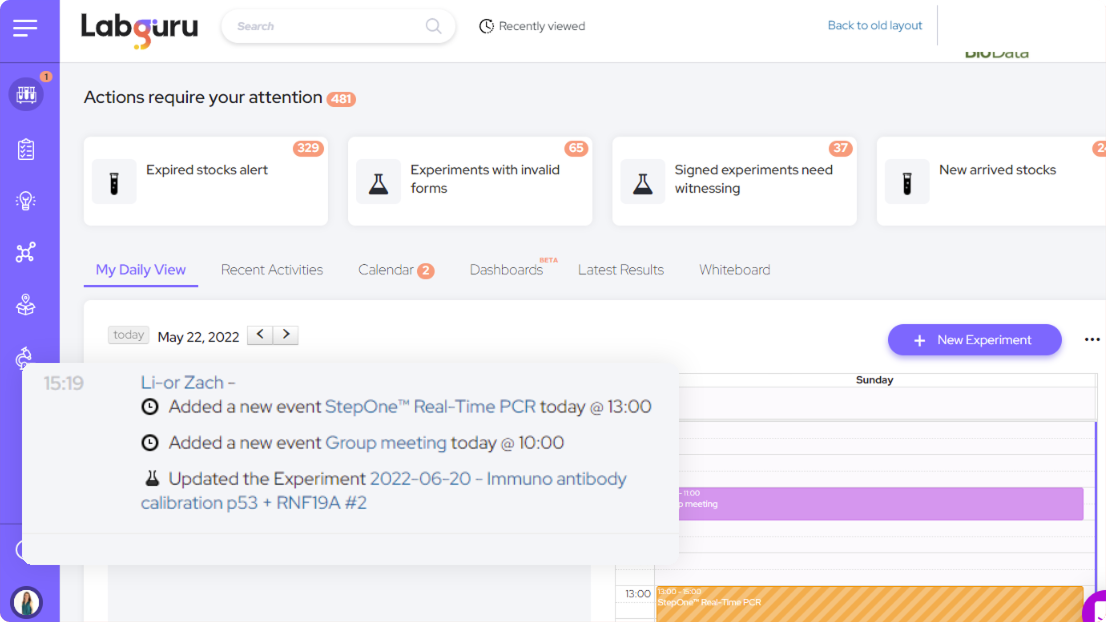
Labguru is a unified platform integrating Laboratory Informatics software with Electronic Lab Notebook and Lab Information Management System. It’s built for life science and pharmaceutical companies.
Implementation speed: Labguru marketing materials suggest their system can be configured and made operational quickly, but no specific timelines are mentioned on the website. Based on real user reviews, it takes at least two months to deploy the system.
Configurability: Labguru offers built-in configuration tools that allow labs to tailor workflows, forms, templates, and data fields to their processes. Users can customize experiment structures, inventory tracking, reports, and dashboards without deep technical work. It works well for research-focused labs, though more complex or regulated workflows may require extra setup.
Integration capabilities: Labguru provides extensive APIs to connect with lab instruments, other software (like SAP and Scispot), data analysis tools (R, Spotfire), and external databases. Plus, we shouldn’t forget that Labguru is an integrated solution that combines LIMS and ELN in one place.
Total cost of ownership: Labguru doesn't publish pricing, so you'll need to request a custom quote. But it provides a free trial and covers data migration from your existing LIMS/ELN at no charge.
If you need details on how 1LIMS and Labguru differ, see our honest comparison.
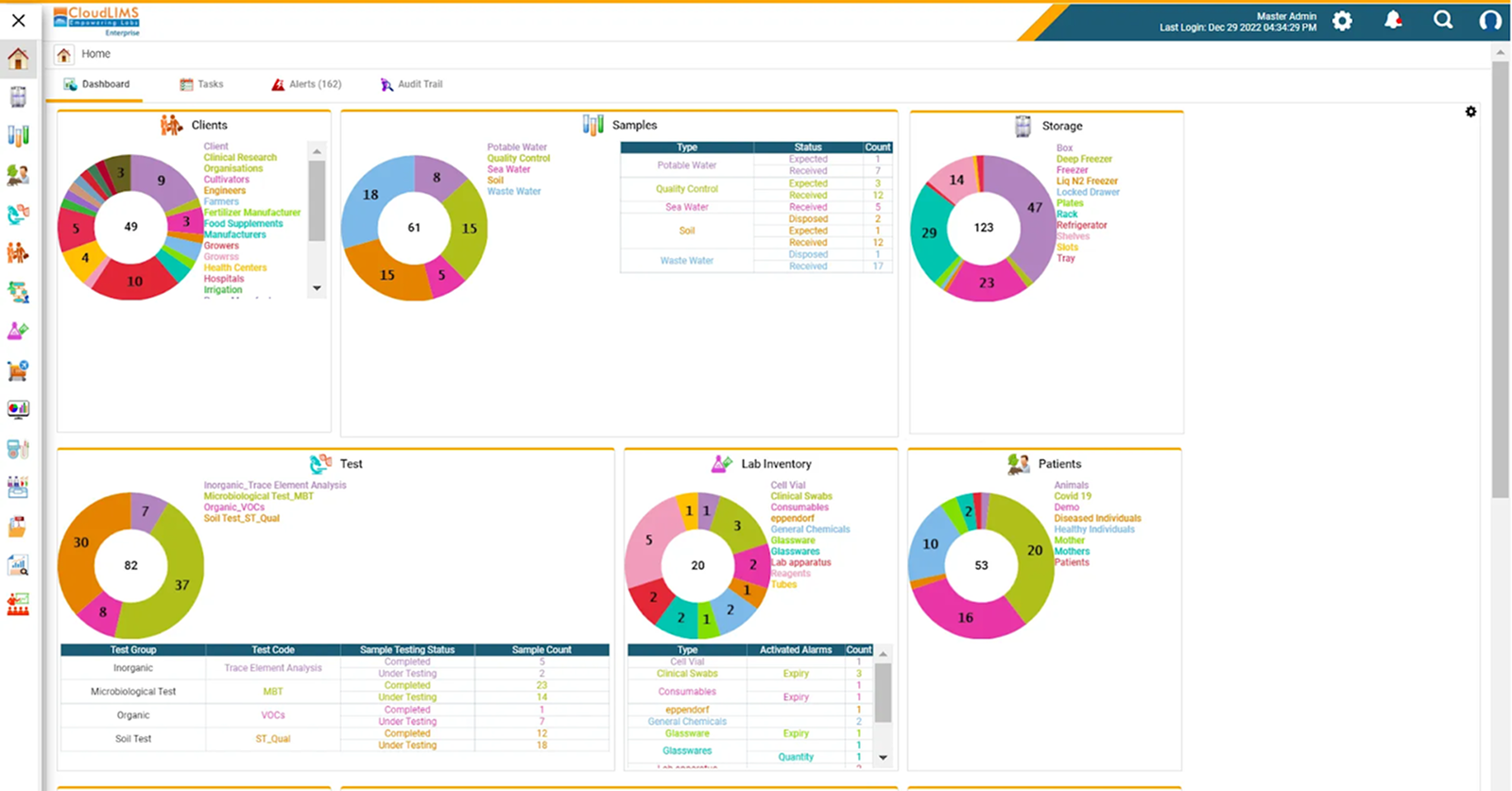
CloudLIMS is a versatile SaaS platform that serves laboratories across various industries. The system’s core strength lies in biobanks, clinical diagnostics, research, and analytical testing labs, but it has also expanded into mining, cannabis, veterinary, and other specialized sectors. That range works great if you're running multiple lab types, but niche labs often gain more from a system built for their specific workflows.
Implementation speed: CloudLIMS states that their cloud-based system can be implemented in 4-6 weeks, but actual timelines vary based on lab complexity, data migration needs, and integration requirements.
Configurability: CloudLIMS is a configurable platform that allows users to create custom workflows, applications, and reports. Laboratories can also use the embedded configuration tools and customize them to meet their process automation needs.
Integration capabilities: CloudLIMS connects with a wide range of lab instruments using CSV or Excel file imports. It also supports integrations with external systems such as EMR/EHR, LIS, patient registries, and billing software (e.g., QuickBooks) via REST API. In addition, CloudLIMS connects with third-party providers, including NirogGyan, PhlebX, Hurdle, and more.
Total cost of ownership: CloudLIMS has three pricing tiers designed for different types of laboratories. Within each tier, pricing is charged per user per month and decreases as the number of users increases. For example, teams with up to 5 users pay about $285 per user per month, while teams with around 100 users see rates closer to $42 per user per month.
The company also offers complimentary services like technical support, product training, instrument integration, and more.
We’ve also done a direct comparison of CloudLIMS and 1LIMS in case this is on your shortlist.
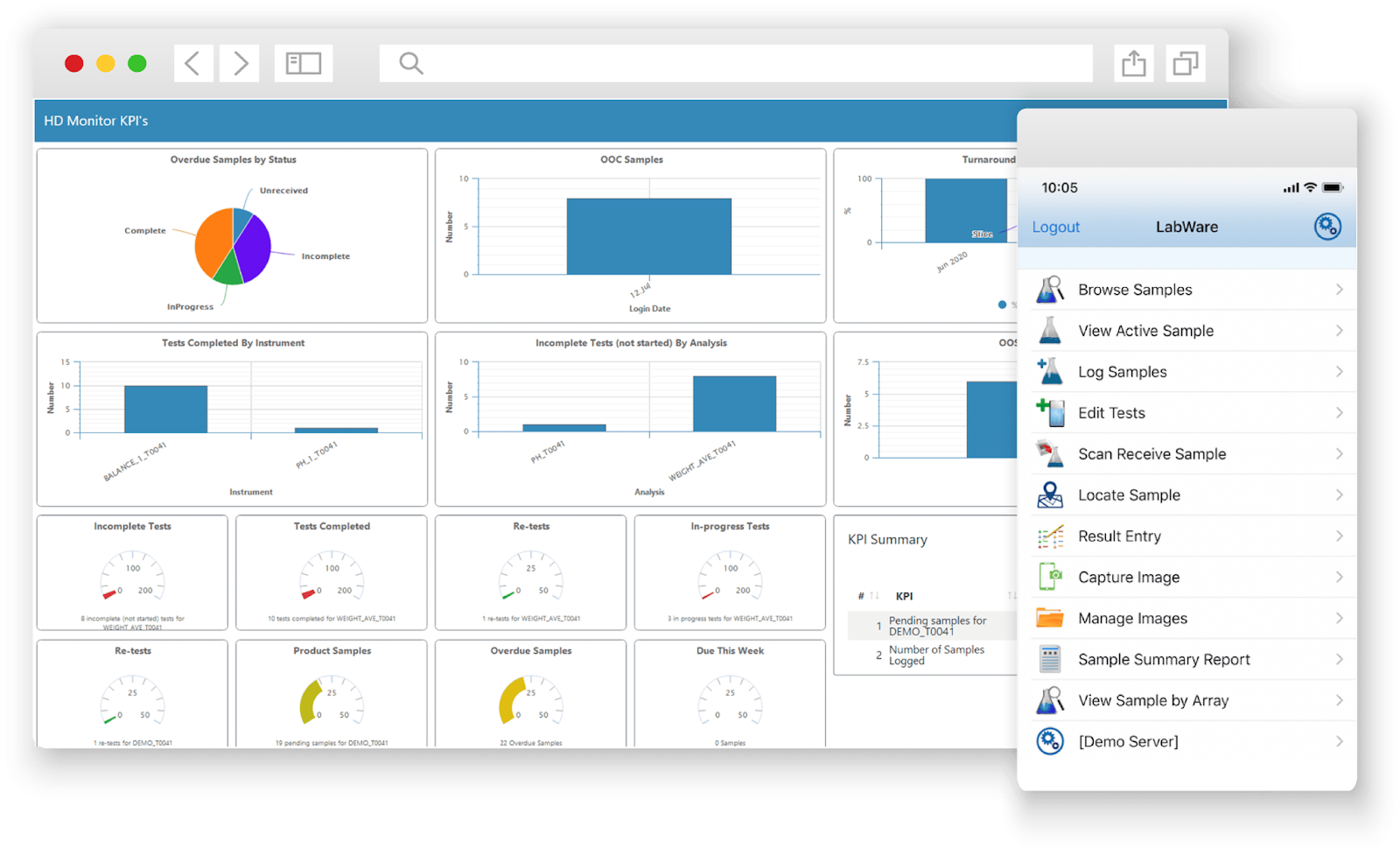
LabWare is a global leader in laboratory information management systems trusted by over 29,000 labs worldwide. Their client list covers NIH, USDA, GSK, Pfizer, Chevron, and Johnson & Johnson. In general, LabWare looks like an all-in-one solution with toolkits for pharmaceuticals, petrochemicals, food safety, environmental labs, and other sectors.
Implementation speed: LabWare can be deployed on-premises and in the cloud. Their fastest option, LabWare SaaS, can go live in 30 days. But that timeline assumes you're working with their standard configuration. Custom deployments, however, can stretch into months.
Configurability: LabWare offers industry-based templates that help labs deploy faster with proven best-practice workflows. If a lab has more complex or unique processes, LabWare allows deeper configuration. It means teams can choose a faster setup or invest in customization, depending on how much flexibility they need versus how quickly they want to deploy.
Integration capabilities: LabWare integrates directly with lab equipment and provides secure API and third-party integrations, including SAP, Waters Empower, and other ERP and CDS platforms.
Total cost of ownership: LabWare does not list prices publicly. To get official pricing, you should request a quote through their website. But we do know its SaaS option is the most affordable and quickest to roll out compared to other deployment models.
Sapio Sciences is a lab informatics platform that connects LIMS, ELaiN (AI Lab Notebook), and Scientific Data Cloud on a shared AI foundation. It delivers solutions for scientific research, discovery, manufacturing, and clinical diagnostics.
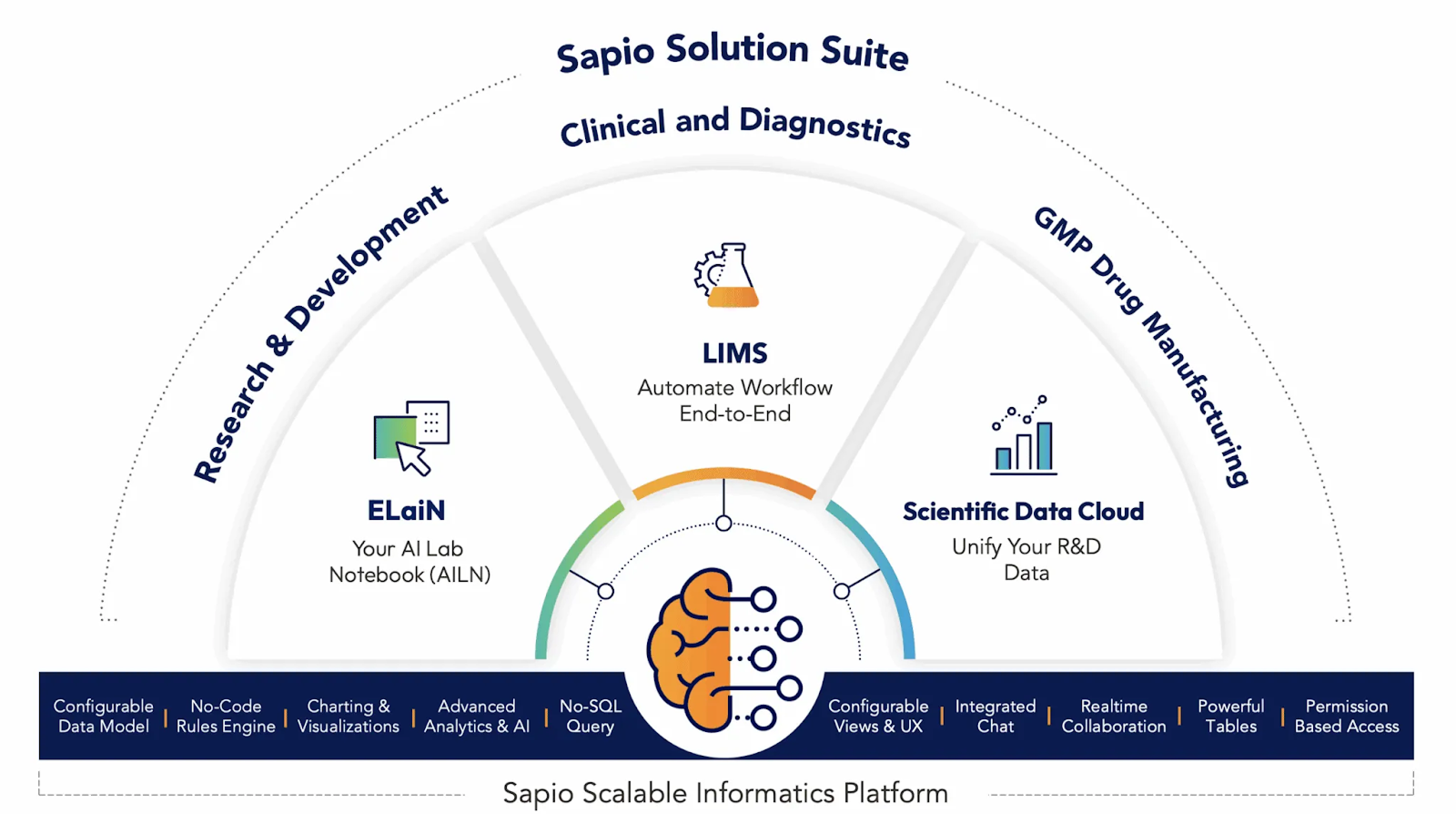
Implementation speed: Sapio does not publish fixed implementation timelines, as deployments are tailored to each lab. However, the company positions its platform as one that can be deployed in weeks rather than years.
Configurability: Sapio LIMS is built as a no-code, configurable system that lets scientists and lab teams tailor workflows, rules, forms, and processes. It uses visual builders, drag-and-drop tools, and rule engines, so labs can adapt the system to their unique needs without heavy IT involvement.
Integration capabilities: Sapio handles integrations through three main channels: a no-code rules engine for workflow automation, file transfer tools for data exchange, and APIs for custom connections. The platform comes preconfigured for standard lab instruments, like Bioanalyzers, LC-MS systems, and qPCR machines. Beyond equipment, Sapio integrates with third-party analytical software, like Waters Corporation, a leading provider of lab equipment, supplies and software for scientists.
Total cost of ownership: Sapio pricing is flexible and modular, but not transparent upfront. What you pay depends on which applications and bundles you need. For instance, a standalone Sapio LIMS, ELaiN with LIMS, or packaged solutions for NGS, diagnostics, or bioanalytical labs.
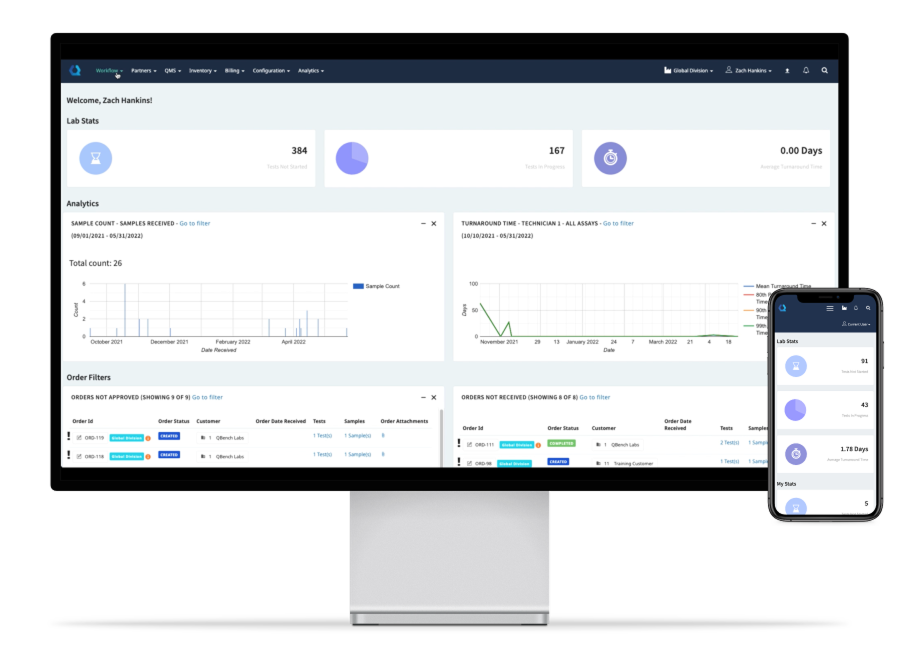
When you research QBench, you'll find a modern, cloud-based LIMS that doesn't pick favorites. Agriculture, consumer goods, life sciences, manufacturing, materials testing, and more. If your lab runs samples and generates data, QBench wants to work with you.
Implementation speed: Implementing QBench can take around 3-4 months. However, some customers report going live in a few weeks, while others cite implementation timelines of around 40 days.
Configurability: With QBench, you can modify workflows and field names to match your terminology, define role-based access, tag data types for flexible organization, and add custom IDs to orders, samples, and projects. Fields can be added, removed, or rearranged per data type.
Integration capabilities: QBench supports instrument integration and external system connectivity through APIs and file-based data exchange. It also integrates with customer portals, billing systems, and other business tools frequently used by testing labs. Its integrations page features multiple third-party integrations, including QuickBooks, Oracle NetSuite, Salesforce CRM, ClickUp, and more.
Total cost of ownership: Subscription pricing ranges from $275/user per month for the Foundation plan to $425/user per month for the Advanced plan. Beyond subscriptions, expect $5,000-$10,000 for implementation and training as upfront costs. Plus, custom integrations built and managed by QBench will cost you around $125/month.
If you're expecting us to tell you which LIMS to buy, sorry, not happening. No article can make that call for you. Only you understand your lab's reality with its workflows, constraints, and needs.
But we can help you make that decision with clarity. Here's a short evaluation checklist to find the right LIMS for your lab:
1. Get specific about requirements: document your laboratory's specific needs, including type, size, regulatory environment, and priority capabilities.
2. Shortlist vendors: identify 3-5 vendors best aligned with your laboratory type and requirements.
3. Request demos: schedule vendor demos focused on your workflows and provide specific scenarios from your laboratory.
4. Check references: talk to 2-3 labs like yours that went live recently with the solution you consider.
5. Demand transparent pricing: request detailed TCO proposals including all costs (licensing, implementation, training, support, integration, ongoing modifications).
6. Choose for today: pick the vendor that solves your current problems. You need a system that works when you go live.
When you apply this checklist, you’ll see once again that not all LIMS vendors are built for the same type of lab. Even if they look similar at first glance. Some prioritize research flexibility, others focus on enterprise scale. 1LIMS is designed for QC and manufacturing labs, where speed, standardization, and audit readiness matter more than open-ended experimentation. Compared to other vendors, we offer a much more accessible entry cost and a predictable recurring investment.
Privacy is important to us, so you have the option of disabling certain types of storage that may not be necessary for the basic functioning of the website. Blocking categories may impact your experience on the website. More information